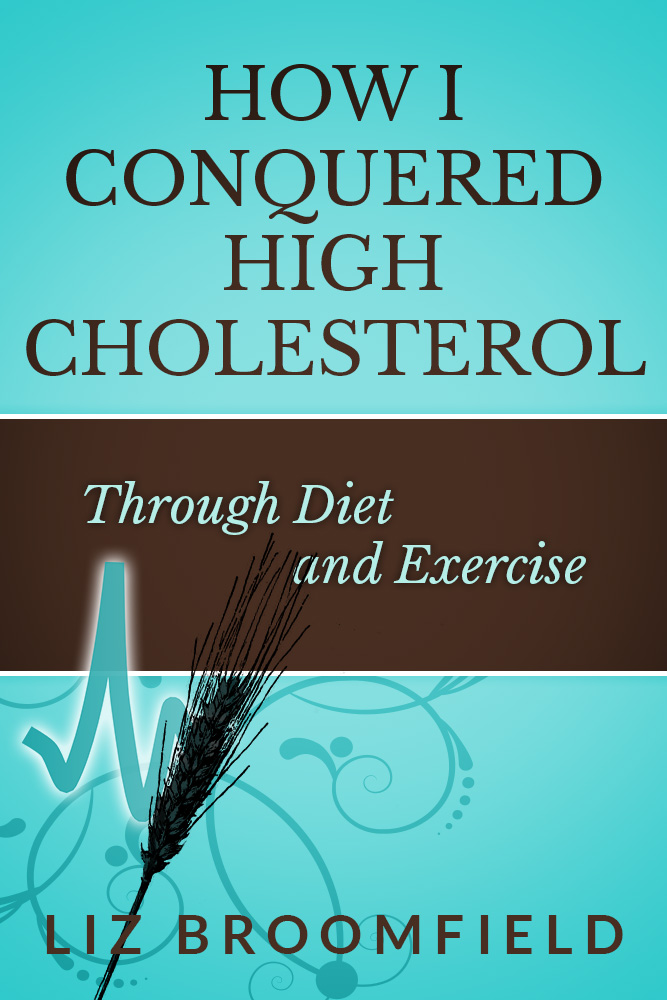
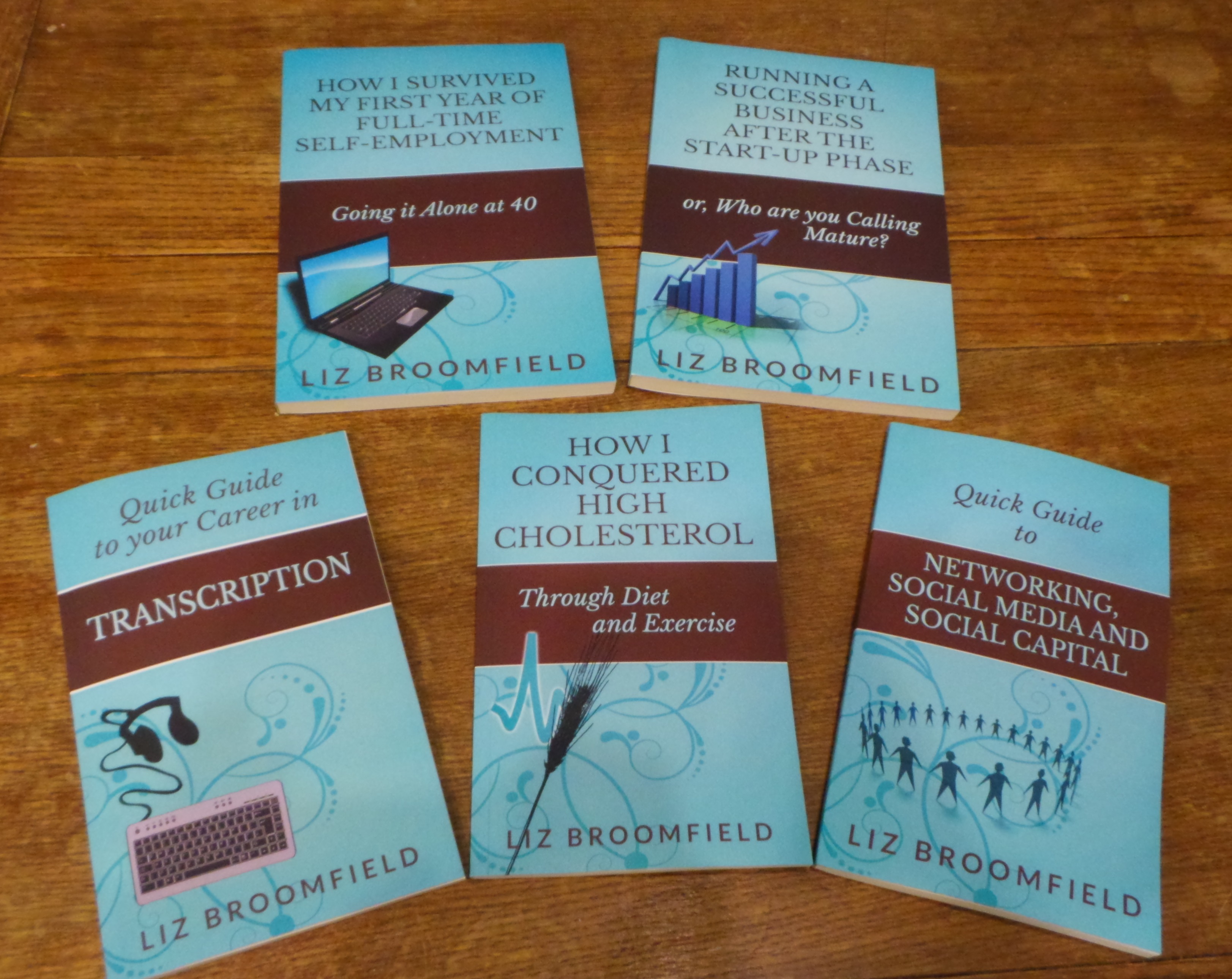
All of my books for small business (and my book on beating high cholesterol) are now available in print editions

Liz Broomfield books

I’m really excited to announce that all of my books are now available in print editions, as well as the e-books which have always been available. This was in response to some market research that I did, and also people reaching out to me to ask whether and when the books would be available in print.

The new ones – the Quick Guides and How I Conquered High Cholesterol – are in a handy 5″ x 8″ format, so nice and easy to pop into your bag. They are priced as low as I can – I have never believed in charging a huge premium and making a large profit on either my print or e versions, so please be assured that they are priced to take into account the royalty that Amazon takes, the cost of production (in the case of the print books) and a small profit for me. I want to make sure they’re accessible.

The print books were produced through CreateSpace so available on a print-on-demand basis from Amazon. I know some people aren’t keen on Amazon – I’m committed to helping lobby the government on tax avoidance, but unfortunately Amazon is the main market for me. However, if you’re not keen on buying from there, you can buy my e-books from Smashwords and the very independent Selz, so hopefully that gives you enough options.

If you buy one of my print editions, please let me know and tell me what you think about it. If you take a photo of yourself or something representing your business with the book, I will post it on my photos and reviews page on this website, with a link to your business if you’d like.

Phew – it’s been hard work, but hopefully it will be worth it in terms of getting my books into the hands of people who they can help. That’s what it’s all about for me.

If you want to find out more about how any of these books can help you start and build your business, network and work with social media, take up a career in transcription or manage your cholesterol, do take a look at the individual pages for the books …

How I Survived my First Year of Full-Time Self-Employment | Running a Successful Business after the Start-up Phase | Quick Guide to Networking, Social Media and Social Capital | Quick Guide to your Career in Transcription | How I Conquered High Cholesterol

PS I made screen shots as I created my print versions and I’m planning to post instructions on here detailing exactly how I did that – would you find that useful? I’ve also blogged about whether this venture is proving successful.

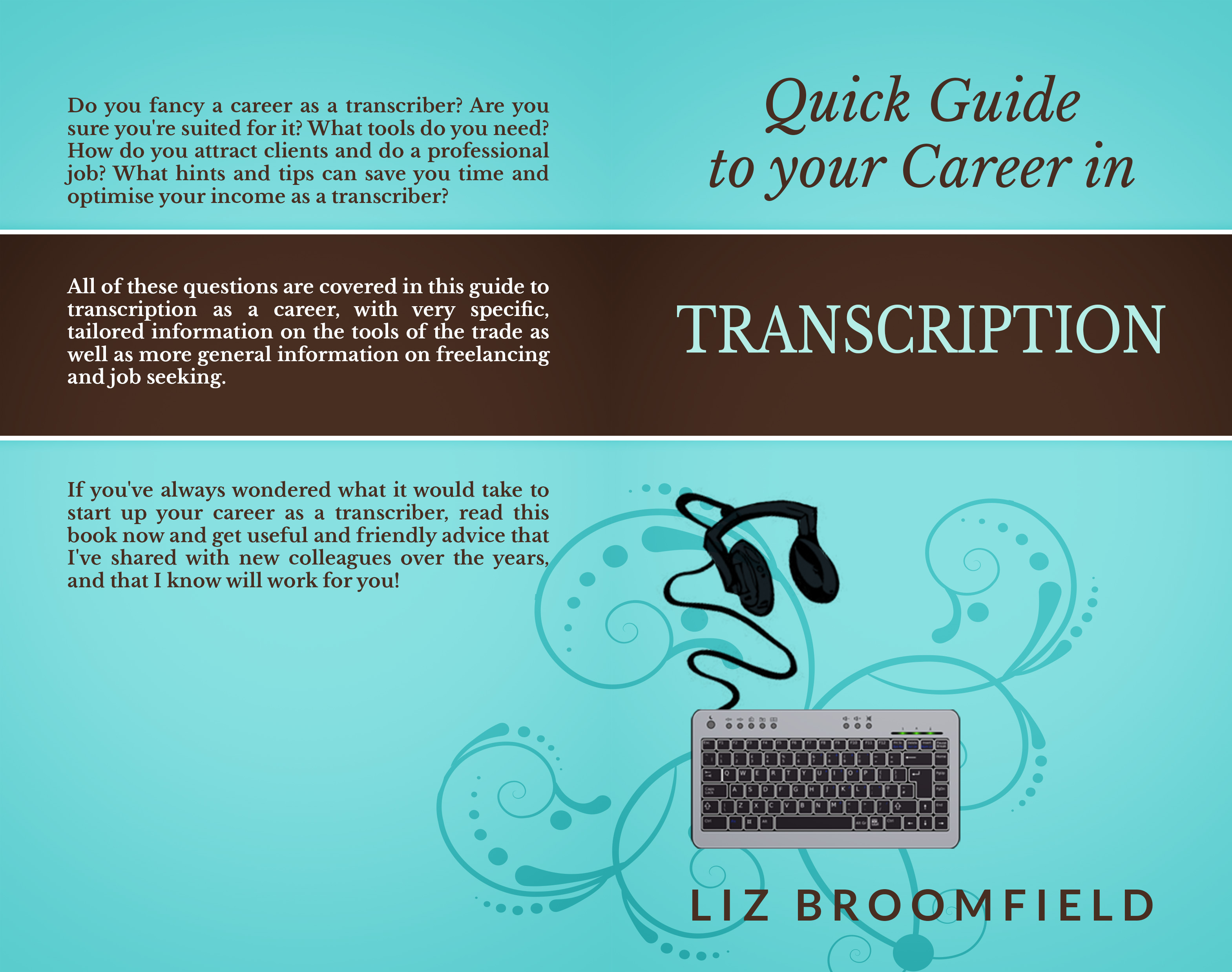
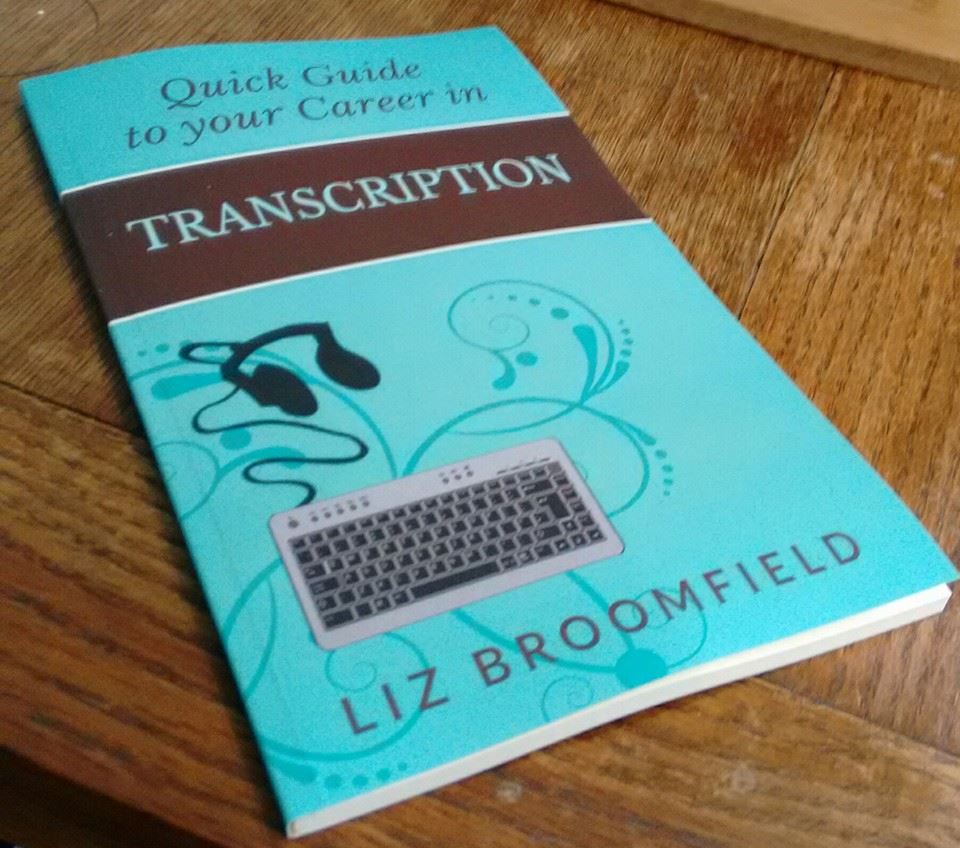
Print edition of Quick Guide to your Career in Transcription available now!

Quick Guide to your career in transcription print versionI’m thrilled to announce that I’ve finally got a print version of my popular “Quick Guide to your Career in Transcription” available in the shops. You can buy it from all versions of Amazon – pop over to the book’s page for a full set of links but you can see it here on Amazon UK. Market research has suggested that people are keen on reading print versions as well as e-books, so I’ve listened to my readers, friends and fans, and here you go!

It’s retailing at £4.50 in the UK (with the e-book still at £1.99) and I hope this means that I help even more people with no-nonsense and jargon-free information – there’s even a section to help you educate your own clients!

If yQuick Guide to your career in transcription paper versionou buy a print copy of this book, do send me a photo of you with the book or the book somewhere you have been, as I do like to see them in real life (and if you have a link or page, I will pop that on my Photos Page too as a little thank you). Here’s a photo of the print book in the flesh, so to speak (in the paper?):

Watch out for print editions coming in a week or so for “Quick Guide to Networking, Social Media and Social Capital” and “How I Conquered High Cholesterol”. I’m on a roll!

Fiction, non-fiction and creativity – an interview with author Steve Dunham

hand writingWelcome to a new interview in my series on creativity in non-fiction writing, and today we’re welcoming Steve Dunham, editor and writer. I “met” Steve when we did a review exchange – he reviewed my “How I Survived My First Year of Full-Time Self-Employment” on his blog, and I reviewed his “The Editor’s Companion” on mine. Like me, Steve is primarily a non-fiction writer, but that doesn’t stop him having some good and interesting things to say about creativity – he even creatively added to my standard list of questions (which is perfectly acceptable, of course!).

Hello, Steve. So, tell me a bit about yourself and your books.

I’ve been working as an editor since 1981 and writing for publication a bit longer than that. “The Editor’s Companion”, published in 2014, is based on what I’ve learned and collected in that time. My friend and agent Dave Fessenden (also an editor and writer) pestered me to start the Editor’s Companion blog, which is new, too. I had put almost everything I could think of about editing into the book, so it’s been kind of hard to come up with new blog content as well. I’ve been involved in public transportation advocacy (citizens’ groups) almost as long as I’ve been writing and editing, so that’s a subject I like to write about too.

How did you start writing, and which came first, fiction or non-fiction?

I studied journalistic writing in college, and I worked on the college newspaper, and that heavily influenced everything I wrote after that—nearly all of which has been nonfiction, except for occasional humor.

What did you write in all those years before getting a book published?

I’ve been employed as an editor for most of my adult life, so a lot my writing and editing are done at work: newsletters, articles, journals, radio public-service announcements, press releases, catalogs, corporate reports. In 1999 our local newspaper asked for commuters to write freelance columns once a month, and I sent a writing sample and got assigned to write the “Commuter Crossroads” column, alternating with other writers. This was fun and lasted about ten years. Most of the columns are archived on my website. I also started writing some humor columns, sometimes in “Commuter Crossroads” and often in “Commuter Weekly”, which used to be distributed on trains in the Washington, D.C., area. I really hoped to become a syndicated columnist, but it hasn’t happened yet.

One of my sons took a college course in screenwriting, and I asked him for his textbook when he was done with it. I was sure I could write screenplays. I studied that book and the materials on Wordplay, written by two Hollywood screenwriters. Then I wrote two screenplays, both fiction: “Accomplice to Terror” and “Mars and Venus Attack!” I haven’t sold either one yet, but they’re fairly new, written in 2013 and 2014, respectively. Those are on my website too. I would like to sell at least one before pursuing a couple of nonfiction screenplays I have in mind.

So your book “The Editor’s Companion” was a long time in the making. What’s the story behind that?

I was on the faculty of a writers’ conference in St. Louis in 1996, and one of the faculty members said we should write a book together about editing. It sounded good to me, so I came up with an outline, divided the work between us, and wrote my half. I never got anything from the other writer, and I had chosen the topics I knew something about, so I didn’t really know how to finish the book. It lay fallow for years, and then around 2010 I decided to finish it on my own, having acquired a little more knowledge I could apply. I wrote the rest of the book, and I showed it to Dave Fessenden, who loved it and offered to be my agent. He got a contract with Writer’s Digest Books, which asked for something like 65 more pages—in a few weeks! I told Dave that I couldn’t write 65 more pages if they gave me a few years. What I did was come up with a lot more content that didn’t require much writing—bloopers I’d seen in print and online, samples of editing, questions I’d answered—and all this made it a better book, not to mention the editing the publisher did.

I recently blogged about finding that writing non-fiction was still “creative”. Do you agree, or is only fiction writing truly creative?

Nonfiction can be creative. Some years ago I applied to a Master’s program in writing, and I was rejected. It emphasized creative writing, including creative nonfiction. The Creative Nonfiction website describes it as true stories, well told. The writer presents the factual story but captures not only the facts of who, what, when, where, and why, but the atmosphere and the details that illuminate the facts, so that it reads like literature. The writer doesn’t make things up but goes beyond the factual material of journalistic writing. In contrast, just about all my writing, even my screenplays that came straight out of my imagination and are creative in that sense, is journalistic writing, not literature.

Have you got anything else you want to add about creativity and writing (with particular regard to non-fiction)?

I think that creativity can come into play with nonfiction when you write anything that doesn’t follow a formula. Lots of nonfiction writing does follow a formula, and there’s nothing wrong with that. News stories typically use inverted pyramid style, and documents such as directories are more useful if the information in each item is arranged the same way. Often, though, I’ve attended a conference or interviewed someone and then looked through my notes and any materials I collected, and I had to decide what story could be told with the things I gathered and whether anything was missing. Since I mostly write short pieces such as journal articles, I generally don’t need a written outline. Once I decide what the story is, I concentrate on the first sentence, which I usually write in my head. I may spend a good bit of time mulling it over, but I’ve found that once I have the first sentence written, the rest of it comes easily.

Thank you for all those thoughts and your view of creativity in non-fiction! Finally, please tell us where we can find you and your books!

“The Editor’s Companion” is available from the publisher and from Amazon and Amazon UK. My screenplays, book reviews, and articles are on my website, Steve Dunham’s Trains of Thought.

You can read new interviews in the series, either by subscribing to this blog (see the links in the top right if you’re viewing on a PC or on the drop-down menu if you’re reading on a phone or tablet) or clicking on the “non-fiction creativity” tag at the top of this post, which will give you access to all the interviews published so far, as well. Happy reading!

My own books are all firmly in the non-fiction area, but I do involve aspects of my own life and experience to make them more accessible and welcoming. Take a look by exploring the links on this page, or by visiting the books pages.
Fiction, non-fiction and creativity – an interview with author Jeff Deck

hand writingWelcome to a new interview in my series on creativity in non-fiction writing. Today we meet Jeff Deck, who I first came across when I read his excellent memoir / travel book about correcting typos across America, “The Great Typo Hunt” (read my review here).  Jeff’s next project was a fiction book, so he is well placed to talk about creativity in both, and he’s obviously done a lot of thinking about the topic. Read on to see what he has to say …

Hi there, Jeff. First off, tell me a bit about yourself and your books.

Hi, Liz. I’m an indie author who writes science fiction, horror, and fantasy. My new e-book is “Player Choice”, a sci-fi gaming adventure. In a former life, I published a nonfiction book called “The Great Typo Hunt: Two Friends Changing the World, One Correction at a Time”, with Random House.

How did you start writing, and which came first, fiction or non-fiction?

Fiction came first for me—and then nonfiction—and now I’m back to fiction! It’s the circle of life!

I was a creative writing major in college. My thesis was a horror novel that my advisor, an accomplished literary fiction author in his own right, did his best to take seriously (“Nice story, but do you really need a monster?”).

After I graduated, I spent several years improving my writing via various fiction projects, a few in tandem with my writer friend Benjamin D. Herson. We made some attempts to get the traditional publishing industry interested in our work. But it was like trying to breach a fortress. You need either a really good battering ram—or you need to know a guy on the inside. Otherwise you won’t even get past the front gate. In those days, the traditional route was the only real option.

Benjamin and I did get into the fortress eventually, but with a completely different project, and without the intention to do so. We took a road trip around the United States to fix typos on signs, blogged about it, and got a lot of major media coverage. Agents and editors came calling. Thus the nonfiction book “The Great Typo Hunt” was born.

Fiction was still my main squeeze, though. I resurrected a book I’d been working on in the old days. One that just needed a little more love, and, say, five or six more drafts. By the time the novel reached peak level of awesomeness, I realized two things:

1) Because this book was fiction, not nonfiction, I’d be basically starting over if I pursued the traditional publishing industry. My agent was mainly a nonfiction rep. My remaining contacts at Random House were all in nonfiction as well.

2) The publishing world is a lot different than it was in, say, 2005. Advanced technology has created a large audience of e-book consumers. And a writer can reach this audience directly without having to rely on traditional publishers. E-book prices are set lower than physical books, but being able to earn 60-70% of the cover price per sale rather than 12-15% is a big deal.

So I went indie with my fiction. And here we are with the newly released “Player Choice”.

That’s an interesting move, as many people want to go from indie to traditional publisher. But it seems right for you, and that’s what matters! Now, I recently blogged about finding that writing non-fiction was still “creative”. Do you agree, or is only fiction writing truly creative?

I think we have to be careful with this “creative” label. Just like with the “literary” label that we only apply to certain types of books. These criteria are highly subjective.

But to me, creativity manifests itself in nonfiction as well as fiction—and in cooking, and woodworking, and math, and pretty much anywhere else people can use their grey matter to come up with new ideas and innovative solutions to problems.

Maybe it’s different for textbooks, or the manual for a Kenmore vacuum. But while writing “The Great Typo Hunt”, Benjamin and I had to draw on all of our creative powers to make our narrative as entertaining and compelling as we felt the account of our real-world adventures deserved.

We pondered whether first-person singular or plural (or third person!) would be the best way to tell the story. We turned to research, historical events, and the great carnival of the internet to bolster our points in the book or to make chapters more entertaining. We put a lot of thought into what specific turns of phrase, structure, and vocabulary would make our scene descriptions funnier.

If Malcolm Gladwell had been the one to correct typos around the U.S.—doing all the same things we did—his version of the book “The Great Typo Hunt” would still be radically different. He has his own writing style, his own way of thinking, and his own ideas about what to emphasize. If Elizabeth Gilbert, or Bill Bryson, or Mary Roach had taken the trip, we’d see still more examples of drastically different approaches to the same raw material.

Again, with the possible exception of describing how a vacuum cleaner operates, there are a million different ways to approach the same raw material when writing nonfiction. That’s where our individual creativity comes in.

And also, of course, that’s why we should remain skeptical of nonfiction as a source of authority. It’s never the Word of God, even when it pretends to be.

I’ve heard it said that memoir should be considered as “creative non-fiction” – do you agree with that description? How do you think writing memoir differ from writing fiction on the one hand and non-fiction on the other?

If we accept that nonfiction has the capacity to be creative, then memoir is certainly a part of that. It’s an especially good example of creative nonfiction because you are speaking in your voice about your life. You’re not an objective reporter. You’re a storyteller in a tradition that goes back to ancient warriors boasting around the fire about their own exploits.

I think we can still classify other types of nonfiction as creative, while at the same time recognizing the desire for more objectivity in those cases.

An author can inject wonderful personality and color into, say, a book about a certain historical time period (see Ian Mortimer’s “The Time Traveler’s Guide to Elizabethan England” for a great example of this).

But we’d also hope that the author can give us as unbiased and fact-based a look as possible at that period. We’d want the work to be “creative” in the sense of “originality of thought” rather than the other, facetious meaning of the word—”taking liberties with the truth.”

If you use your own life in your fiction, was writing a memoir different from doing that?

“The Great Typo Hunt” was inescapably about my own life. “Player Choice”, on the other hand, takes little pieces from my life in far subtler ways. Most fiction is like that. Even stories set in the most outlandish worlds, starring the most alien characters, will still contain little nuggets of their author’s own outlook and experiences. It’s nearly impossible to take yourself completely out of it.

The focus on virtual-reality gaming in “Player Choice” comes directly from my own interest in video games and future tech, of course. And there are aspects of Glen’s (the main character’s) personality and background that mirror my own (how his single-minded focus on a project endangers his relationships; having an abusive figure in his childhood, etc.).

But my own life also informs the story in less obvious ways. I assign the roles of heroes and villains (and everyone who exists in the grey area between) based on my experiences and my moral outlook.

Another writer—say somebody who grew up on a farm in Caribou, Maine—might have made the technophobes in Player Choice the good guys instead. A writer who’s spent thirty years as an advertising executive might not have painted the ads of the year 2040 in the intrusive, cranium-busting way that I have. Ayn Rand would have made my libertarian firebrand Freya the indisputable heroine of the book.

That’s an interesting perspective, thank you. Finally, please tell us where we can find you and your books!

You can find more about me and my books on my website. “Player Choice” is available wherever e-books are sold. For three bucks. Here are the  links on Amazon and Nook  to get you started.

“The Great Typo Hunt” is available wherever you can buy books, period. Except for that used-book store down on the corner of 19th and Lodgepole, the one that smells like ham sandwiches all the time. Don’t bother looking there.

You can read new interviews in the series, either by subscribing to this blog (see the links in the top right if you’re viewing on a PC or on the drop-down menu if you’re reading on a phone or tablet) or clicking on the “non-fiction creativity” tag at the top of this post, which will give you access to all the interviews published so far, as well. Happy reading!

My own books are all firmly in the non-fiction area, but I do involve aspects of my own life and experience to make them more accessible and welcoming. Take a look by exploring the links on this page, or by visiting the books pages.
Ten 5-star reviews for “Quick Guide to your Career in Transcription”

quick guide to your career in transcriptionThe ninth five-star review for “Quick Guide to your Career in Transcription” on Amazon.co.uk (and tenth five-star review in total) was posted this week! This is definitely a book I wrote in response to interest, as I noticed that I was getting a lot of searches coming through to my website on transcription, transcription careers, etc. I’d been writing odd bits on the subject but put this book together – and I’m so glad I did! I’m hoping to produce a printed version, too, after a couple of enquiries convinced me that that would be a good idea – watch this space for news on that one!

that will be very helpful and useful to me I’m so impressed with this fabulous book, which explains everything so clearly and concisely … I was able to highlight plenty of relevant points in the book, that will be very helpful and useful to me. (Read full review here.)

By the way, it’s worth noting that on the day I received this review, I noted that I sold …

  • Some copies of my e-books via Amazon
  • A print copy of my book “How I Survived my First Year of Full-Time Self-Employment” via Amazon
  • An e-copy of my Business Omnibus via Smashwords
  • A PDF of my Cholesterol book via Selz

So it’s certainly working for me having as many different formats and platforms as I can!

Stop press – all of my books are now available in PDF via the Selz website – you can buy using PayPal, too!

For more information and how to buy, visit the “Quick Guide to your Career in Transcription” page.

“How I Survived my First Year of Full-Time Self-Employment” receives its 25th 4 or 5 star review!

How I survived my first year of full-time self-employment I was thrilled to notice I’ve had my 25th review (all 4 or 5 stars) on Amazon.co.uk (it’s got three more on Amazon.com) for “How I Survived my First Year of Full-Time Self-Employment“. I’m really proud of this book, and I’m enjoying rejigging it for the new edition purely for proofreaders and editors – I’m glad I shared my own experiences to write the book I wished I’d been able to read when I was starting out – everything was so pushy and risk-it-all or else wishy-washy without good worked examples and detailed information.

A really useful perspective … It has given me plenty to think about, but also boosted my confidence that I, too, can build a successful business. Thanks Liz! (Read the full review on Amazon)

I’m always glad to know when I’ve boosted someone’s confidence – that’s what I set out to do and it’s gratifying to know that it’s worked!

Read more about “How I Survived my First Year of Full-Time Self-Employment” including how and where to buy.

Fiction, non-fiction and creativity – an interview with author Jane Badger

hand writingWelcome to a new interview in my series on creativity in non-fiction writing. Today we’re having a chat with Jane Badger. I met Jane because of her blog on pony books, and I own her marvellous history of the pony book, “Heroines on Horseback”, which I reviewed over on my book review blog, but she’s also a fellow-editor and writer of both non-fiction and fiction, so a great person to mine for information and thoughts on my topic. Oh, and didn’t we ALL write some very odd fiction for our English Language ‘O’ Level, if we did one? I certainly recall producing a very miserable piece about a dying carthorse, inspired by a Christmas card from a pile with which we were all issued in the middle of an exam. See – I do write creatively, too (hm).

Hello, Jane, and thank you for joining the discussion! First, please tell us a bit about yourself and your books.

I spend most of my life crawling over what other people write, adding what I fondly hope are tactful comments asking them to explain this ambiguity, and check that inconsistent fact. My one published book so far is “Heroines on Horseback”, which is an examination of the pony story in English literature. I’ve also written a sequel to Ruby Ferguson’s “Jill” books, which I hope will be published next year.

How did you start writing, and which came first, fiction or non-fiction?

As a teenager I wrote very odd fiction for English Language O’ level, but that was about it as far as fiction went. I was far happier writing funny stuff for the school magazine, to the horror of my English teacher, who wrote on my report that I’d get on far better once I’d learned to channel my eccentricity. Once my children arrived, I wrote pieces for the local NCT magazine, and when I became a bookseller, starting writing a website about my speciality, pony books. On the back of that I wrote a general blog with book reviews, and life in my garden: anything, really, as long as it wasn’t too personal. I was asked to write a book on the history of the pony book by specialist publishers Girls Gone By, who have the patience of saints because it took me years to deliver the goods.

At various points when I was writing the book, I do remember thinking that writing fiction must be so much easier because you didn’t have to do a month of solid research before you could even begin a chapter. That didn’t stop me thinking that yes, writing fiction was more creative, because you just made stuff up out of your beautiful imagination, and it all made sense, and you had a plot, and characters, and you said profound things, and made acute observations. About life. Whereas what I did was analyse stuff. And attempt to be vaguely amusing about it. Full stop.

I was then asked to write a time slip pony story, and agreed because I thought if I committed to it then I might do it, and I was interested to see whether I could actually write a work of fiction. So, I started off, not at all sure what was going to happen. What happened was that I got a few chapters in, got bored, and so did what I tend to do when bored, prevaricate. I am a highly experienced prevaricator, and am good at doing something that could justifiably be described as contributing to the thing I’m avoiding doing, whilst still not actually doing it. I’d been contributing to one of those memes where you write a paragraph, and someone else writes a paragraph and so in the end a story emerges. I was contributing to this with gusto, and then wrote a paragraph in which Ruby Ferguson’s Jill appeared, and explained what she’d been up to since the series finished.

Ah ha, I thought. I really want to see what Jill did do after she disappointed generations of readers by tamely agreeing to do a secretarial course rather than go off and work with horses. And whilst it’s not exactly writing my time slip story, it is historical, because it’s set in the 1950s, and I will use it as an exercise to practise writing fiction, because what I will do is write it online, chapter by chapter, and see what people think. And if I write it online, I will get plenty of comment, which is good, because I do like being edited, and if I am tempted to prevaricate and not do it, I will be doing so very publicly and that might be enough to make me stick to it. And I will learn masses of lessons on how to write fiction and I will use them to finish my time slip story.

It sort of worked – Jill is a fantastically popular figure, and so plenty of people were interested in what I was doing, and made whole heaps of useful comments. As I was using characters I knew extremely well, I found it fairly easy to set them going and then write about what they did, which in itself was a very useful lesson. Having people comment as I went along was incredibly useful, and led to me re-jigging the plot and changing a lot of things. And I did finish it.

The time slip story is still languishing, just as I left it. I did write a Nanowrimo novel last year, but hated the process with a passion. I like to write in short chunks which I polish and polish and polish, and having to churn out thousands of words in a day was awful. I did it, but haven’t looked at the ghastly book since, because the emotion I recollect in the relative tranquillity of now is still loathing.

Did you always want to write non-fiction or was this a relatively late development?

There are masses of things I want to write, mostly non-fiction, but the ones I get paid for have a magnetic attraction. But yes, I was glad to provide in “Heroines on Horseback” a resource that I hope will be useful for all fans of the pony book.

I’d like to write a book on the welter of stuff that surrounds the horse world and how it has changed over the last hundred years or so: why the elephant ear Jodhpur? Why the jute rug? Who else lusted over the Jacatex ads for cheap riding clothes?

I’d also like to write more horse history. What I have been asked to write is more fiction, so we’ll see.

I started this whole series off when I blogged about finding that writing non-fiction was still “creative”. Do you agree, or is only fiction writing truly creative?

It is creative, but in a different way. You need to be creative in order to create something readable out of a whole welter of facts.

I’ve heard it said that memoir should be considered as “creative non-fiction” – do you agree with that description? How do you think writing memoir differs from writing fiction on the one hand and non-fiction on the other?

In the sense that you’re putting your own particular gloss on something, then yes, I suppose you are being creative. I do write the odd autobiographical piece, and if they’re going to be any good, I think you actually need to reveal something of yourself. Or be amusing. Or preferably both. Certainly the autobiographical pieces I’ve written that have had the strongest reaction have been the ones where I have said this is how I feel about what’s happened. It’s not something I do often.

If you use your own life in your fiction, was writing a memoir different from doing that?

I’ve never written a memoir, so I don’t know. The secretarial college in my Jill book was based on the one I went to (albeit in the 1980s, but the college was really out of the Ark), and I used bits of my London life.

Have you got anything else you want to add about creativity and writing (with particular regard to non-fiction)?

Go with what you love. I love research, and exploring new things that crop up, and then lassoing the whole lot into something that makes sense, and I hope entertains.

Thank you so much for that! Now, tell us where we can find your books …

My website is at www.janebadgerbooks.co.uk. Heroines on Horseback is available from the usual sources (Waterstones, Amazon, Book Depository), or from me if you want a signed copy. Jill I hope will see the light of day as an actual book sometime in 2015 but nothing’s set in stone yet! Until that point, you can dig her out on my forum here (though this isn’t the final version – just what I wrote online).

You can read new interviews in the series, either by subscribing to this blog (see the links in the top right if you’re viewing on a PC or on the drop-down menu if you’re reading on a phone or tablet) or clicking on the “non-fiction creativity” tag at the top of this post, which will give you access to all the interviews published so far, as well. Happy reading!

My own books are all firmly in the non-fiction area, but I do involve aspects of my own life and experience to make them more accessible and welcoming. Take a look by exploring the links on this page, or by visiting the books pages.

A lovely new long review for “How I Survived my First Year of Full-Time Self-Employment”

How I survived my first year of full-time self-employmentAuthor and editor Steve Dunham has posted a lovely long and detailed review of “How I Survived my First Year of Full-Time Self-Employment” over on his blog. We did a review swap – I reviewed his “Editor’s Companion” on my own book review blog but, just like doing competitions offering free books or giving physical copies to reviewers or any other of the myriad ways we try to get our books out there, you can never assume that a) you’re going to get a good review, b) you’re going to get more than a one-liner, or c) you’re going to get a review at all.

Steve really “got” what I was trying to do with the book …

Liz invites you to take a walk with her through the year, encounter the ups and downs with her, and learn the lessons as she learns them.

and has understood that I’m explaining my process as an example, not a prescription:

Liz describes her methods for scheduling work and keeping accounts, knowing that readers will need to devise their own ways of organizing pieces of a business, and simply offers her ways as an example. Her description of how she handles her bookkeeping will encourage you to do yours promptly and regularly, even if your system is different. If you’re self-employed, or thinking about it, just reading how she does things will probably give you ideas for your own business.

It’s not a puff piece – Steve makes the very valid point that I wrote this (partly unintentionally) for a UK audience, and I will address this issue in the version I’m rewriting specifically for editors and proofreaders, making sure I explain British terms and provide dollar conversions, so I’m glad he reminded me of this. It’s also true that different kinds of readers will like the different levels of detail on various topics in the book (I know some people who’ve loved the bits on tea; others have memorably criticised me for including too many cardigans!).

So it’s a very fair review, with a lot of detail and understanding – and that’s the best kind of review, in (of!) my books. Thank you to Steve, and I’m glad he found my book worthwhile.

Read more about “How I Survived my First Year of Full-Time Self-Employment” including how and where to buy.

Fiction, non-fiction and creativity – an interview with author Laura Quigley

hand writingWelcome to a new interview in my series on creativity in non-fiction writing. Today I’m excited to introduce you to Laura Quigley, who writes all sorts of things, including non-fiction and fiction, as well as plays, audio and TV scripts. In fact, she started out writing plays, but found that her interest in research led her to move into the non-fiction book arena. Laura’s got some very interesting points to make about research and non-fiction – have a look at last week’s interview with Linda Gillard for more on the research process. I love the subtle differences and similarities we’re building up as this interview series continues! 

Hello, Laura. Tell me a bit about yourself and your books.

I’m Laura Quigley and you name it, I write it: TV, audio, books, plays, short stories. I’m based in Plymouth UK, bringing up two brilliant kids and trying to keep my partner sane while he works ridiculous hours. I’ve got four books out – 3 non-fiction, the 4th is a time-travelling adventure for kids of all ages.

How did you start writing, and which came first, fiction or non-fiction?

Fiction came first, but not in books. I studied screenwriting and I was doing well with stage plays but the Arts Council cut the budget which prevented my award-winning play from touring. At the same time, theatre hours and family hours weren’t mixing well, so I thought, “write it as a book”. The play was based on a true story from the English Civil War,  so I approached the History Press and got the research published, and that quickly followed with a commission to write “Bloody British History: Plymouth” for them. Then I wrote “South West Secret Agents” for them, which got me into Plymouth’s International Book Festival, appearing alongside more famous, literary writers!

In the meantime, a new publisher was looking for someone to write a new series of time-travelling fiction for them (www.forelock-books.co.uk) and that turned out so well, they want at least three more from me! And I work regularly now in both fiction and non-fiction – to me, it’s all story-telling, but some of the stories are all the more remarkable for being true.

Did you always want to write non-fiction or was this a relatively late development?

I’ve been writing since I was nine and I won a poetry contest. I’ve always written and I keep practically every word – it’s amazing how often I go back to an idea from when I was a teenager. I studied drama, media, film and television at University and did very well academically, probably achieving more than I did creatively in the setting. I wanted to go into film production but ended up in educational publishing/management (long story!) until I had kids. Then suddenly I couldn’t work full-time and writing was a job I could fit around the family. So I’ve always written. Yet it seems I’m only just now finding my ‘voice’.

I recently blogged about finding that writing non-fiction was still “creative”. Do you agree, or is only fiction writing truly creative?

Anything involving the craft of language is creative. However, what you are asking is a very complicated issue because there’s more to communication and crafting language than being creative, and yet creativity is key. I write narrative non-fiction, so there’s a lot of research involved and an academic mind-set helps with ordering and structuring the information. But I’m also telling a story and that requires shaping the language, modifying the flow of words, bringing the past to life, getting into the heads of the people I’m describing. There’s a lot of that in fiction too, obviously, and also a surprising amount of research in fiction! Sometimes the only difference I can see between the two is that for fiction I don’t have to have footnotes and a bibliography. Some might see fiction as less factual and more emotive, but the best non-fiction is also emotive, whether that’s nostalgia or self-help, history or travel guides. (Michael Wood’s “In the Footsteps of Alexander the Great” is non-fiction, but read that delicious prose – a fine example of emotive non-fiction.)

In short, I use the same skill sets for both, on a sliding scale between creativity and logical analysis.

I’ve heard it said that memoir should be considered as “creative non-fiction” – do you agree with that description? How do you think writing memoir differ from writing fiction on the one hand and non-fiction on the other?

If it’s based on fact, including memory, then it’s non-fiction and all non-fiction has an element of creativity, so I don’t see the need to distinguish memoir. Museums are full of memoir! In a way, all history is memoir, just some of it is in first person.

If you use your own life in your fiction, was writing a memoir different from doing that?

I use all my own senses in my fiction, but memoir is recording how it actually was, while fiction is inspired by the emotional realities while not necessarily recording the facts. Life inspires. Memoir records. Imagination helps in our understanding in both non-fiction and fiction, but non-fiction tries to stick to the facts. Fiction can be about creating new realities, inventing new scenarios. Memoir is exploring reality as it was. Difficult distinction, but there is a definite distinction between the two.

Have you got anything else you want to add about creativity and writing (with particular regard to non-fiction)?

As part of my research, I read a lot of non-fiction writers who could benefit from a course in creative writing, not because I want them to learn to make stuff up – far from it! But there are ways of telling a story in an interesting, compelling way and there are ways of putting facts in a series on a page that will bore the pants off the readers.

Great non-fiction writers (and teachers) communicate the facts using creative language and story-telling techniques. I’m not just talking about popular history presenters here either. I’m talking lecturers in business studies, chemistry professors, self-help gurus, renowned political commentators, journalists…the list goes on. Human beings communicate in stories that utilise language and all great stories communicate truths about the human condition and the world we live in. Non-fiction and fiction writers all have to learn to use these tools we’ve been given most effectively to get the message across.

Thank you so much for those thoughts, Laura! Tell us where we can find your books!

My website is currently: www.lauraquigleywriteyourstory.weebly.com

My fiction is at: www.forelockbooks.co.uk

My audio fiction is at: http://wordofmouthproductions1.wordpress.com/2014/09/18/ghost-stories-uk/

My non-fiction is easiest to find on Amazon.

And if you’d like to read my most popular blog post to date, which is about writing non-fiction, it’s here.

You can read new interviews in the series, either by subscribing to this blog (see the links in the top right if you’re viewing on a PC or on the drop-down menu if you’re reading on a phone or tablet) or clicking on the “non-fiction creativity” tag at the top of this post, which will give you access to all the interviews published so far, as well. Happy reading!

My own books are all firmly in the non-fiction area, but I do involve aspects of my own life and experience to make them more accessible and welcoming. Take a look by exploring the links on this page, or by visiting the books pages.
A note from a happy reader of “How I Conquered High Cholesterol”

How I conquered high cholesterolI love hearing from my readers – I’m sure all writers do. I didn’t really imagine that anyone would get in touch with me when I published my first one, although I carefully leave contact details in the backs of all of my books. Anyway, I’ve got used to it now, but it never palls, and I was thrilled to hear from Paul Beverley, of Norwich, in the UK, who had read my book on  how I reduced my cholesterol and wanted to ask me some questions about soluble fibre, apples and oats (as you do). We corresponded back and forth a little, and I was pleased to see that he was doing well with his health.

Just a few days ago, I received an email from Paul with very good news. I should add that I quote this with his permission, and that both he and I agree that it’s not all down to me, and my suggestions based on my experience won’t help everyone with high cholesterol. But this is what he said, and it was SO LOVELY to read this:

I’ve just had the results, and I’m pleased to report that the BP is “normal” and the cholesterol is “normal”. The actual level is 4.5!

Yay! Way to go! Once again, thanks for the book. It was an inspiration, knowing that someone else had managed it.

A GP friend at church said, “No-one ever manages to get it down by diet and exercise by more than one point.”

All together now: “Oh yes they do!”

How lovely! Thank you, Paul, for getting in touch, and I’m so glad I could help – that’s what I do it all for!

Read more about How I Conquered High Cholesterol, including where to buy, here.