Fiction, non-fiction and creativity – a group interview

hand writingWhen I wrote about creativity in non-fiction writing and invited fellow non-fiction writers to take part in an interview series on the subject, I had a huge response. Some of the messages I received were very long, some were more concise, and if I published them all one by one, I’d be holding interviews back for months). So, here I’m going to do a sort of group interview with a selection of non-fiction writers – I hope you enjoy this format, just to mix things up a  bit! There won’t be an answer from each person to every question, but you can follow their paths through their writing lives …

So, today we’re meeting Robin Stevens (who writes under the pseudonym Rhabi Rites), Wayne T. Ollick and Richard W. Bender, all of whom have been inspired to publish books on issues and topics which are important to them.

Hello everyone! Tell me a bit about yourselves first, please …

Robin Stevens: My name is Robin Stevens but my pseudonym is Rhabi Rites.  I was a foster child at the age of 5 months old to be later adopted in the Stevens family.  I am originally from Greensboro, NC and have been living here since birth.  I am a playwright and director as well as an author.  I enjoy the outdoors and love animals.  My hobbies are cooking, singing, writing, and hiking, although I don’t get to hike much these days.

Wayne T. Ollick: I am retired and became very involved in politics, for the first time in my life, when Liberalism/Progressivism took over the country. I forward, highlight and comment on articles that I receive each day to about 300 followers

Richard W. Bender: I write non-fiction only, about the things I do and some of my experiences.  I have been blessed with unique creativity and great opportunities in my life and I have a lot to teach and share. My first book, “Herbal Bonsai”, is out of print after selling more than 10,000 copies and my second book, “Bountiful Bonsai” is due out in January, 2015 and is available for preorder at Amazon.

How did you start writing, and which came first, fiction or non-fiction?

Robin: I first started writing when involved in a domestic violent relationship back in 2000.  Writing became a way of escape..my peace and I have been writing ever since.  My first writings were scripts to stage plays and then came poems, song lyrics and monologues.  My latest is the novel Delivered, I wrote in 2013.  Non-fiction came first for me because most of my writings were based on my life. I hated writing in school, which is funny to me now.  English was my worst subject and one day while in college, one of my English professors told me that my essay writing was so expressive and that I should consider writing one day.  That was back in 1988. I did not start to write until 2000.

Wayne: As I mentioned, I recently became very involved in politics. I believe the number one problem in the USA is the inability of people in both parties to communicate. This all-consuming schism has  occurred twice before in our history. First, at the time of the Revolutionary War (Patriots and Loyalists) and second, just before and during the Civil War (those for slavery [Southern Democrats] and those against [The newly formed Republican Party]). My book addresses today’s schism, especially in my chapter on, “The Plight of the Baby Boomers”.

Did you always want to write (a memoir / non-fiction) or was this a relatively late development?

Richard: I told my parents I would be an outdoor writer when my age was still in single digits.  I never started writing seriously until I was in my thirties and had my first articles published in newspapers and magazines at the age of 34.

Wayne: I call myself a ‘Sophichologist’, a made up word that is a composite of the words, Sociology, Philosophy, and Psychology, my main interests of which, I believe, are overlapping disciplines. So the idea of writing about my thoughts has always existed but I never actually thought I would write a book. I was talking to a friend around 2008 and telling him that I feel like Dr. McCoy (of the Star Trek movie) must have felt when Mr. Spock used a mind meld to transfer all of his knowledge into McCoy’s head, as Spock was about to die saving the ship. [I am sorry if you are not a fan of Star Trek, which might make this analogy tedious.] Anyhow, I had 40 years of thoughts in my head that were screaming to come out and suddenly I realized that the only way that will happen is to write a book. In 2009 I started.

I recently blogged about finding that writing non-fiction was still “creative”. Do you agree, or is only fiction writing truly creative?

Wayne: I absolutely agree! While writing, I am always finding ways to creatively format and arrange the content in a manner that will hold the reader’s interest. Adding anecdotes and humor is also a tool I use to bring home a point in a way in which the reader can identify or be amused.

Richard: Nonfiction is creative.  I write about the creative things I do and am working on a collection of philosophical essays about experiences in my life that could be considered a memoir and I call creative nonfiction.

Robin: The most a writer can do to make their writings interesting is to use fiction.  We all have lives, experiences, things we have been through but until you add that spin, that fictional edge, all you have are words.  Stories need a “twist”.  Plays need a “turn” something that will lead the person down the road they are familiar with only to give them a detour..which keeps it interesting in my opinion. Then you have an audience who are wondering where the story will go next.  This keeps them coming back for more.  So in writing your non-fiction, give the readers what they expect, but also give them more of what they didn’t.

I’ve heard it said that memoir should be considered as “creative non-fiction” – do you agree with that description? How do you think writing memoir differ from writing fiction on the one hand and non-fiction on the other?

Richard: I don’t write fiction, but consider myself a storyteller.  My stories happen to be about real experiences from my life. My nonfiction articles and books are about imparting information.  My memoir essays have to tell a story that keeps the reader interested, much like fiction and I consider that to be creative nonfiction.

Robin: I would not agree with the statement that a memoir should be considered “creative non-fiction.”  Any memoir I’ve ever read was based on a true story and depending I guess upon the author, the “creativity” would be based on what those memories were.  This makes it non-fiction.  Authors can however add to their memories to make them seem interesting but most I’ve read do not.  I myself am a creative writer, descriptive in my writings, but to write one of these would be totally based on fact.  If that’s creative, so be it.  There’s nothing wrong with making your story “pop”, but I would say if an author writes about their memories, those memories are precious and many times are left alone.

Wayne: I am a bad person to respond to that question. I wrote my book in the third person because I wanted it to be solely about the content and not about me. So, I would never consider writing my memoirs or an autobiography. Those are for highly accomplished people, in my opinion. But, if you are going to write about yourself, you had better be creative, or your audience may get quite bored.

Have you got anything else you want to add about creativity and writing (with particular regard to non-fiction)?

Wayne: I have read non-creative non-fiction and it read like a technical manual. Think about the difference between a teacher that simply voices the material while writing it on the board (I’ve had a lot of those!) as opposed to one who gets the class involved by asking their opinions before he tells them the facts. I should say that I am a fan of the ‘Socratic’ method of teaching in which Socrates would ask his pupils a series of questions until they came upon the answer on their own.

Robin’s book, “Delivered”, written under the pen-name Rhabi Rites, is located on the Xlibris.com website under fiction and it can be found on amazon.com and barnesandnoble.com.

Wayne T Ollick has a website and Facebook page and you can buy his book, “The Overviewer” from Amazon or direct from CreateSpace.

Both of Richard W. Bender’s books can be found at his author page at Amazon. People can follow what he’s doing and learn about new works in progress by following his author page on Facebook.

I think you’ll agree that this is an interesting selection of answers from a group of very different people who turn out to agree on a lot!

Watch out for more interviews, either by subscribing to this blog (see the links in the top right if you’re viewing on a PC or on the drop-down menu if you’re reading on a phone or tablet) or clicking on the “non-fiction creativity” tag.
 

First 5-star review for my “Quick Guide to Networking, Social Media and Social Capital” on Amazon.com

I’ve just received a lovely five-star review for “Quick Guide to Networking, Social Media and Social Capital” on Amazon.com!

Quick guide to networking, social media and social capital

It’s particularly nice that the reviewer is a social media expert themselves, but still found points of interest and recommends it to novices:

Great pointers and perfect for beginners! … This is a great book to have in your business resources arsenal!

See the full review on Amazon.com here. I don’t get so many reviews (or sales) on Amazon.com as on the UK site, but the reviews from there copy across to the other regional Amazon sites, so this is extra-valuable to me.

By the way, I don’t know why it says pricing info is not available – it’s $2.99 and that shows up when you visit my author page. Maybe that’s because I’m looking from the UK.

P.S. I know an increasing amount of people are not keen on purchasing from Amazon and there are calls to boycott them in December. All of my e-books are also available on Smashwords, for the same price, and downloadable for Kindle, Kobo, Sony eReader, in pdf, etc. They’re also in the iBooks Store on your iPhone. So there are lots of choices if you don’t want to use Amazon.

——————–

Find out more about “Quick Guide to Networking, Social Media and Social Capital” here. Read about my other books here.

Fiction, non-fiction and creativity – an interview with author Paul Magrs

hand writingI recently wrote a post about creativity in non-fiction writing and then had the idea of inviting some of my writing friends and acquaintances to take part in an interview series on the subject. I’m going to be publishing these interviews over the next few months (yes, I’ve had a great response, yes, you can still take part, just pop and have a look at the original post for instructions).

Today I’m delighted to kick the series off with a chat with author Paul Magrs. I originally got in touch with Paul when I found a mention of my hobby of BookCrossing in his lovely novel, “Exchange”. We’ve become friends, I’ve enjoyed reading all of his books apart from the one that was a bit too scary for me (it’s actually fine, I’m just easily scared) and, as he’s recently published a work of non-fiction, his part-memoir, part-cat biography, “The Story of Fester Cat“, I was interested to find out how the creative process for that book differed from his fiction writing. Let’s meet Paul and find out more …

Hello Paul! First of all please tell us a bit about yourself and your books.

I’m a literature PhD who taught the Creative Writing MA at UEA during my twenties and thirties, and next year sees the twentieth anniversary of the publication of my first novel. I’ve written magical realism, queer fantasy, science fiction, domestic thrillers, camp screwball comedies and Gothic mysteries. My newest release is ‘The Story of Fester Cat’ published by Penguin US and my next book is a YA science fiction novel, ‘Lost on Mars’, coming out with Firefly in the spring.

So, how did you start writing, and which came first, fiction or non-fiction?

Fiction came first of all, from a very young age. It was all endless practice till I was at university and found out you could do courses and workshops in this stuff.

You’ve recently published your memoir / cat biography: did you always want to write what we’re loosely going to call non-fiction (see below) or was this a relatively late development?

I’ve always been a devoted keeper of journals and diaries. All my writing practice involves warm-up sessions and these most often involve memoir-work. Well before I published any, I’d written a great deal of non-fiction, or hybridized fiction / non-fiction. When I was at UEA, Julia Bell and I set up the journal ‘Pretext’ in 1999, and that was all about writers and academics exploring forms of writing that blended genres and forms. I wrote a few pieces at that time, including a piece called ‘What Now, My Love’ for Pretext and ‘Here Comes Glad’ for the TLS, and they were my first forays into memoir.

Now, I recently blogged about finding that writing non-fiction was still “creative”. Do you agree, or is only fiction writing truly creative?

They are both creative in different ways. Both are linked to the world outside the book and both have to be summoned up and imagined fully on the page. Some of my favourite non-fictions I read greedily, like I do novels – and some of my favourites teeter between genres. A really good biography will make the person materialize in front of you. It’s not just creative – it’s alchemical.

I’ve heard it said that memoir should be considered as “creative non-fiction” – do you agree with that description? How does writing memoir differ from writing fiction on the one hand and non-fiction on the other?

I see it all as much more fluid than that. Some of those hair-splitting terms can sound so clunky and dry. They’re simply books, aren’t they? And how do you classify books such as some of my favourites – Wayne Koestenbaum’s ‘Jackie Under My Skin’ or ‘Agatha Christie’ by Laura Thompson or Susan Sontag’s ‘Volcano Lover’? They blend biography with fiction and theory.

If you use your own life in your fiction, was writing a memoir different from doing that? And in what ways do you think writing a memoir narrated by a cat was different to writing it in your own voice?

It’s good to come at any material – whether semi-fictional or mostly-‘real’ – from a slantwise direction. An unusual point of view is the classic way of giving yourself a fresh pair of eyes – but also licence to reshape and adapt the raw material. However close to the ostensible ‘truth’, it’s all about taking stuff that’s life-shaped and making it book-shaped.

Have you got anything else you want to add about creativity and writing (with particular regard to non-fiction)?

It was interesting that some editors [the ones at publishers who ended up not taking on the book – interestingly, in the UK] worried about Fester’s book being both fiction and non-fiction at the same time. They wanted strict lines drawing between the two. I think it’s a shame when things have to be so clearly demarcated. It’s a hopeless distinction anyway, I think. When we enter the world of a book it’s all made up, anyway. When I reread Fester’s book at the proof-reading stage I was seeing in my head a version of his story that wasn’t us. It was very weird – I could see a public version of our story, still familiar, but rearranged and reinvented at the same time. Writing is a parallel universe.

That’s very interesting, thank you! Now, tell us where we can find your books!

Many are available online, or in bookshops. The Brenda and Effie Mysteries should be available everywhere. ‘The Story of Fester Cat’ has just been published by Berkley / Penguin in the US and you can find it on Amazon.com, but not in the UK as yet, but it is available as a Kindle book in the UK. You can read more about the book and its reviews on my blog.

I love Paul’s take on this – that genres should blur and it doesn’t matter whether something’s fiction or non-fiction as long as it’s readable. It’s interesting that his editors were concerned about this – I don’t think I’ve worked on anything particularly genre-crossing in my work as an editor myself, but I’ll watch out for making a fuss about things that do so if I don’t need to! I love the quote “It’s all about taking stuff that’s life-shaped and making it book-shaped” – I certainly did that with my first two books, and it makes me think about how I shape my experiences to help other people build theirs.

What a lovely start to the series. Watch out for more interviews, either by subscribing to this blog (see the links in the top right if you’re viewing on a PC or on the drop-down menu if you’re reading on a phone or tablet) or clicking on the “non-fiction creativity” tag at the top of this post.


A new 5-star review for my “Quick Guide to Networking, Social Media and Social Capital”

I’ve had a lovely new five-star review for “Quick Guide to Networking, Social Media and Social Capital”!

Quick guide to networking, social media and social capital

This one was a review copy sent out to someone who’s running a small business and I trust to be honest and careful in their reviewing. I’m really grateful that they were able to put up the review so speedily, as it does help to build the reputation of this new book. L White made plenty of useful comments, including this one …

Very sound, practical and useful advice for businesses … Very helpful advice to anyone unsure why or how to build a social presence, either online or in person.

See the full review on Amazon here. It joins the first two on Smashwords/Amazon and Goodreads, which I posted about the other day. I’m so pleased that people are seeing the worth in this book and that my hard work on it is paying off in terms of being able to help people.

——————–

Find out more about “Quick Guide to Networking, Social Media and Social Capital” here. Read about my other books here.

Calling non-fiction writers …

hand writingI’ve been musing over the whole “am I creative” thing recently after writing my blog post on the topic, and, especially as I’ve been working on writing up my academic research, crafting, synthesising, describing and polishing, and pondering the differences between the creativity of the non-fiction and fiction writer. If there are any.

So I’m calling on non-fiction writers here, including memoir-writers and especially those people who have written both fiction and non-fiction (whether that’s novels and textbooks, poems and articles …). Talk to me about this! What’s the difference between fiction and non-fiction writing in terms of creativity?

I’d love to publish interviews with some of you on this topic (and you will of course get your name on here, plus links to your website and any places you sell your books). Here are some guide questions. Just pop your answers back to me via email or using the contact form on this website …

THE QUESTIONS

Answer any or all of these. If there are any questions you wish I’d asked, ask them of yourself! As long as they fit the topic, I’ll include them in your interview!

  • Tell me a bit about yourself and your books (a paragraph will do).
  • How did you start writing, and which came first, fiction or non-fiction?
  • Did you always want to write (a memoir / non-fiction) or was this a relatively late development?
  • I recently blogged about finding that writing non-fiction was still “creative”. Do you agree, or is only fiction writing truly creative?
  • I’ve heard it said that memoir should be considered as “creative non-fiction” – do you agree with that description? How do you think writing memoir differ from writing fiction on the one hand and non-fiction on the other?
  • If you use your own life in your fiction, was writing a memoir different from doing that?
  • Have you got anything else you want to add about creativity and writing (with particular regard to non-fiction)?
  • Tell us where we can find your books!
———-
I really hope I can get a debate going with some of the non-fiction writing folk out there (and feature them here, too, as there seem to be more resources, forums and promotions for fiction folk!) so do please share this post with any non-fiction writers you know!

First reviews are in for “Quick Guide to Networking, Social Media and Social Capital”

My new book, “Quick Guide to Networking, Social Media and Social Capital”, is out now and available on Amazon and Smashwords as an e-book (find all the links on the book’s page on this website).

Quick guide to networking, social media and social capital

And the first reviews are in!

Joanna Penn of the well-known The Creative Penn website and brand, and also an inveterate social media networker and entrepreneurial guru, kindly reviewed the book on Goodreads. Here’s an extract of what she had to say:

… This book will help you to understand the more detailed nuance of social media, with tips on how to use the technical side of Twitter, Facebook, G+ and LinkedIn, as well as how to be generous on the networks and work for mutual benefit with your connections. There’s also a section on the psychology of networking for introverts, which is helpful as many people feel their personality holds them back online.

I particularly like the summing up section, where Liz advises “Be kind.” If everyone online followed this advice, the world would be a fantastic place! A useful little book for the newbie social networker. (Read the full review here)

Linda Bates was one of the first to read this book, and she posted her review on Amazon and Smashwords. It included these words:

Liz has a lovely clarity of style that works especially well for conveying information in an accessible way. I would recommend this guide for anyone who wishes to use social media for a small business or a voluntary organisation such as a drama or Scout group. (Read the full review here)

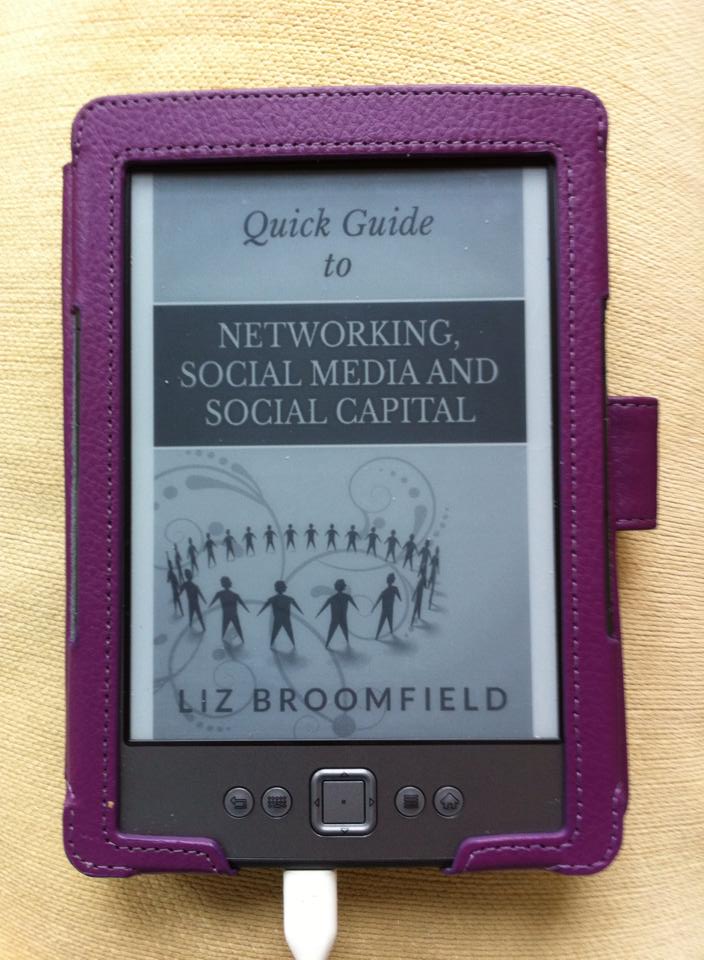
Linda even sent me a photo of the book on her Kindle – it’s great to see how well the cover comes out in black and white!

Networking , social Media and social capital on kindle

I’m so pleased to receive these lovely reviews, and it’s particularly nice to know that these readers have got what I was trying to do – help people, and explain the etiquette of networking face-to-face and via online resources. I don’t specifically state that I’m writing for introverts, but the advice I give does pay attention to those people who do not naturally claim the centre of attention and need to choose their events wisely to avoid exhaustion, and Linda makes a very good point about the wider application of the tips and hints (other feedback has pointed out that it’s good for fundraisers, too).

It’s great to see my new little book out in the world and getting talked about, and I hope it helps a lot of people as it makes its way out through the circles and networks!

——————–

Find out more about “Quick Guide to Networking, Social Media and Social Capital” here. Read about my other books here.

New blog review for “Running a Successful Business after the Start-up Phase”

Running a successful business after the start-up phaseTo be honest, I’ve been a bit disappointed with the reception for this book. I worked really hard on it and filled it with information from my experience on how to develop your business, say no to clients, get your client balance right, get your work-life balance sorted out, blog, engage with social media – all the stuff I think is important once that first rush of starting your business is over and you’re settling in to make it work. I changed the title after some market research that suggested it appeared to be a “growing old gracefully” book, and I ran a competition in my newsletter to win a copy, hoping for some reviews or feedback … that never came.

So I was really pleased when I sent a review copy to business consultant Roland Millward and not only did he tweet about reading it, but he posted a long and careful review on his blog, making sure to tell people all about the book and who it could help. I particularly liked this comment:

“Liz has worked her way through that early period of starting a business and the challenges that self employment brings. She is therefore writing from experience and I believe that you will always learn more from people like Liz.”

and he also pointed out,

“This book is certainly for anyone who has started a business or indeed I would be happy to recommend it if you are considering starting out. The book covers many aspects of business including advertising, social media, blogging, pricing, return on investment, different ways of finding customers and much more.”

Roland also kindly popped a review on Amazon for me, something that we indie publishers always appreciate just as much as a review on a blog. Read Roland Millward’s full review here, and see the Amazon review page here.

A final word: if you enter a competition to win or request a review copy of a book by an independent or small publisher in particular, please do try to post a review, even if the book isn’t for you but you can recommend it to part of your audience. A friend was recently worrying about posting a review of a book an author sent her which she didn’t love. She did, however, explain why it wasn’t quite for her and made it clear who the book would appeal to. She asked my advice and I suggested that she did tell the author about the review, as they would want to know it had actually been read and reviewed. And she received a lovely reply from the author, thanking her for being good-hearted enough to explain her reaction to the book and talk about why he wrote it.

Find out more about “Running a Successful Business after the Start-up Phase” including where and how to buy (Amazon and otherwise, print and e-book).

Why I’m going to stop saying “I’m not creative”

hand writingI was listening to a podcast interview with Joanna Penn the other day where she said words along the lines of, “I used to say I wasn’t creative, but now …” In her case, she had started writing fiction part way through a career that she had thought would be all about writing non-fiction and being a professional speaker. And that fiction is now very successful. I’m not going to suddenly embark upon a spot of novel-writing, but hearing this did set me off on a train of thought.

You see, I’ve always said that I’m “not creative”. “I’m an editor, not a creative writer: it’s two different things,” I would blithely say, as I tucked my editing pencil behind my ear and got on with putting my new guide to social media this, that and the other, or writing a blog post to help people with their time management, or had a good long think about how I could best explain a grammatical concept.

But have you seen the place where ‘they’ define ‘being creative’ as ‘writing novels and poems’? Me neither, when I think about it.

I want to be clear here that I’m not placing creativity above non-creativity. I’m just talking about the idea that more of us are more creative than perhaps we think we are.

What is creativity, anyway?

The dictionary defines creativity around it being the work of imagination and involving new ideas. In fact, I’ve worked on a few academic pieces about creativity, and these kinds of themes come out in those and what I would like to call some heavy research work but actually is more along the lines of skipping through hyperspace following links here and there until I’ve got a list.

For me, creativity involves:

  • Using the imagination
  • Making something exist which didn’t exist before
  • Finding new ways to say things
  • Putting things together in different ways
  • Solving problems
  • Being ‘inspired’

When you look at it that way, you can see that creativity isn’t all about making a painting, a pot or a poem. Of course, it’s all of those things, but it’s more …

In my life, I exhibit creativity in these ways:

  • Creating a business out of nothing except skills and talents and combining areas in different ways – I don’t know many other people who do editing / transcribing / localising / writing but it suits me.
  • Producing edited or transcribed or localised work that’s thoughtful about its author and audience and manipulated in subtle ways to link the two and make a good and useful piece of work.
  • Creating blog posts and other resources that may not be based on completely made-up stories from my imagination, but draw together strands of my experience, new ways of explaining things to people and examples to illuminate points.
  • Being ‘insipired’. “Oh, no, I just write to order and can sit down and produce copy for an hour if I need to,” I say forthrightly. But I would like to point out to myself here that I did have to put back some paid work slightly because this blog post got itself into my head and I had to write it down. Ah.
  • Coming up with reasons why my running partner can carry on and do a few more miles (“We’re nearly up to 35 minutes now!” (looks at watch, which clearly reads 45 minutes; hides watch from running partner).

Just in case you’re feeling I’m being ever so self-aggrandising and arrogant, which is not what I try to be about, here are some more examples of creativity that I see all around me but might not be traditional creativity:

  • My translator friends working with one language to make it represent the nuances of words written in another language
  • A young friend dipping her toe into the world of blogging with gig and record reviews
  • Book reviewers who link the book to others, write about the plot without giving it away and give their readers (or their future self reading their journal) a good idea of whether they’d like the book
  • Business owners forming communities where other people can ask questions and feel supported and valued
  • Networkers who are forever putting people together who they think have something in common
  • Biographers who gather facts about their subject and put them together in a readable and interesting way
  • People who put together lovely, restful, welcoming homes or find a thousandth way to explain to their toddler why they need to put their wellies on
  • Good employment agents who match job profile and candidate for a perfect match

What’s the difference between non-fiction and fiction writing, then?

This is something I’m starting to ponder now, too. When you read an interview with a novelist or poet, there’s usually something in there about how they have to write, how they were scribbling haiku at the age of 3, how they go all weird if they can’t get some writing in every day. Are we non-fiction folks like that? I’m not entirely sure. But then, why do WE write? I have some ideas about why I write — if there are non-fiction writers out there who would like to explore this area more, perhaps in some interviews on this blog, please do get in touch!

In the meantime, I’ll say it …

My name is Liz, and I’m creative

——————

Thank you for reading this article. If you enjoyed it, please do click one of the buttons below to share it. And if you’re interested in my books, which do turn out to be creative after all, have a look here!

My sixth five-star review for “Quick Guide to your Career in Transcription”

quick guide to your career in transcriptionI was chuffed to notice a new review for my book, “Quick Guide to your Career in Transcription“. This one is flying off the (virtual) shelves at the moment, which is cheering as I put together my next offering, another in my “Quick Guides” series. This one on transcription gathers together all of the useful information I wished I’d known when I started doing transcription work (flailing around using non-optimal technology and without the huge range of shortcuts I’ve developed over the years). Transcription is a huge and valued (and fun!) part of my work life; there’s plenty of work to go around and I’m always glad to spread the word: it’s lovely when I hear back from happy readers!

Excellent
This e-book was excellent and to the point! I have been considering starting my own transcription business for a while now and this has given me the extra knowledge and confidence I needed to pursue it! Highly recommend it!!
How lovely! Thank you to this Amazon reviewer, and I hope she does well in her business!
Want to read this book? Have a look here for info and links to Amazon, Smashwords, etc., where you can buy.

My twelfth five-star review for “How I Conquered High Cholesterol”

How I conquered high cholesterolMy book on how I reduced my cholesterol is going strong, having just gained its twelfth 5-star review. Even though all of my other books are on business, I’m fond of this one, which started my publishing “empire” and is helping people every day, which makes me very happy. No longer do people come out of the doctor’s with a 1-page sheet and nowhere to go (well, actually Heart UK do provide some very good leaflets); they can read this book full of practical tips and hints and see exactly how I dealt with my high cholesterol.

In further exciting news, I was recently interviewed for a piece in a health magazine, on this very topic. Hopefully the article will be published in November, and hopefully they’ll be able to mention the book, too (I get a bit embarrassed if it’s all about ME, but I like to help people towards a source of information: once a librarian, always a librarian …

Read more about How I Conquered High Cholesterol, including where to buy, here.