Fiction, non-fiction and creativity – an interview with author Linda Gillard

hand writingIt’s time to pick up the reins of my series of interviews on this blog on creativity in non-fiction writing , and I’m thrilled to introduce my friend and successful indie publisher, Linda Gillard, as we relaunch the series for 2015. I met Linda through my hobby of BookCrossing, well, let’s say several years ago, when her first books, “A Lifetime Burning” and “Emotional Geology” were published by a small press specialising in fiction about the (slightly older) woman. Linda branched out on her own and has now published seven genre-busting, page-turning books about people in interesting situations (from a woman marooned with an ex-soldier in a crumbling castle to someone looking over her own life as she dies, to Gothic romantic suspense goings-on in the Scottish Highlands). Linda started off writing journalism, however, so she has a great view on both sides of the writing fence, and I’m honoured to have interviewed her on her thoughts about creativity in non-fiction and fiction … 

Hello, Linda! We’re old friends, but please humour me for the blog and tell me a bit about yourself and your books

Hello, Liz! I live on the Black Isle in the Scottish Highlands and have been an actress, journalist and teacher. I’m the author of seven novels, including STAR GAZING, short-listed in 2009 for Romantic Novel of the Year and the Robin Jenkins Literary Award (for writing that promotes the Scottish landscape.) My fourth novel, HOUSE OF SILENCE became a Kindle bestseller and was selected by Amazon as one of their Top Ten “Best of 2011” in the Indie Author category. My latest novel, CAULDSTANE, ventures further into the Gothic, and I describe it as a cross between a supernatural thriller and a modern fairy tale.

How did you start writing, and which came first, fiction or non-fiction

I’ve always written something. As a child, I made my own comics and wrote a sci-fi novella when I was a teenager. As an adult I became a writer of long newsy letters. The first time I was paid for producing words was as a freelance journalist. I’d trained and worked as an actress, but I found I had time on my hands, underemployed at the National Theatre and I submitted a few things to magazines which led to a regular column in IDEAL HOME magazine. I also wrote for garden and parenting magazines – mostly lifestyle pieces with a humorous angle. I didn’t start writing fiction until many years later, after I’d given up teaching.

Did you always want to write non-fiction as well as fiction?

I never wanted to do anything other than make up stories. Drifting into lightweight journalism was, I think, an extension of letter-writing and journal-keeping, but I didn’t particularly enjoy it. I found it very hard writing to a word limit and a deadline. I hated the way sub-editors would trim my copy from the bottom of the paragraph up, cutting my punch lines. (I learned to submit fewer words, so they had no need to cut.)

I thought of it as well-paid literary drudgery. I learned a great deal, but I was heartily relieved when I stopped. It was such a relief when I started writing fiction and realised – oh joy! – a chapter could be as long as I wanted it to be.

It sounds like you found your home with fiction, but I know you’ve got some interesting things to say about non-fiction, too. So, I recently blogged about finding that writing non-fiction was still “creative”. Do you agree, or is only fiction writing truly creative?

Yes, I agree. You have to be very creative to present a complex subject to someone who knows little or nothing about it. It’s a challenging exercise in empathy. If you’re trying to convey how gardening can become a passion, even an obsession, you have to imagine what the reader would find interesting about the subject. You are looking for an entertaining angle, particularly with magazine journalism, and your painstaking research mustn’t show. Your object is to make someone read to the end of the article instead of turning the page in search of something more interesting.

When writing non-fiction, you have to hook the reader and keep their attention. These were skills I developed as a journalist and they came in very useful years later when I started writing novels.

I’ve heard it said that memoir should be considered as “creative non-fiction” – do you agree with that description?

There’s a rather glib saying: “All fiction is biography and all biography is fiction”. I think the boundaries are often blurred. I loved Dirk Bogarde’s volumes of autobiography but they entailed (he admitted later) significant lies of omission because he failed to mention his mother’s alcoholism, which he revealed only after she was dead.

I researched ghost writing for my most recent novel, CAULDSTANE and it appears ghost writers of “autobiographies” are aware that some of the stories their subjects tell aren’t actually true, so I suppose you could argue they’re actually ghosting fiction!

Emily Dickinson wrote, “Tell all the truth, but tell it slant”. As soon as you begin to write a memoir you are editing memories. (But memory edits memories!) At best you’re telling the truth-as-you-saw-it, which is probably going to be “slant”.

How do you think writing memoir differs from writing fiction on the one hand and non-fiction on the other?

Fiction and non-fiction (i.e. factual books) have to be believable. Memoir doesn’t, because it’s already “true” – a delightful paradox and one that has led me to describe writing good fiction as “telling true lies”.

I think it’s helpful to look at the different audiences one could be writing for … A reader picking up one of Daphne du Maurier’s novels is looking for a good read, with a beginning, middle and an end. The reader of a guide book to Cornwall wants impressions and verified facts about Cornwall. The reader of a biography of du Maurier wants to know all about Daphne and will probably tolerate a little intelligent speculation.

The biography needs to be interesting and well-written, but it doesn’t actually have to be believable (because we all know truth is stranger than fiction). Nor does a biography have to have a climax two-thirds of the way through, followed by a satisfying resolution tying up all the ends. The subject of a memoir can dwindle into unproductive, boring old age and the reader will forgive. They won’t forgive that in a novel.

What about research? Do authors of fiction and authors of memoir/non-fiction differ in the way they research?

I think they differ in the way they use it.

I assume authors of non-fiction and memoir must love doing research, but I don’t. I much prefer making stuff up. And that’s how I work – I make stuff up, then research it later to see what I got wrong. I prefer to do it this way because it avoids the stodgy info-dump, perpetrated by authors who have spent many hours in the British Library and want their readers to know.

I include only the information necessary to tell the story – and that’s the essential difference, I think. The novelist aims to tell a story, but the author of memoir and non-fiction is more likely to be painting a picture, one that’s big and detailed, possibly comprehensive. The detail is the point. In a novel, the detail is never the point. The story is the point and research must always serve that story.

It can be hard when you come across a really juicy fact to leave it out! But interesting is not the same as useful. The author of fiction must ignore the temptation to include it, but the author of non-fiction can succumb because fascinating facts will add to the overall picture.

Pace is an issue for the author of non-fiction, but it’s less of an issue. Readers don’t expect non-fiction to be un-put-downable (though of course the best is! Margaret Forster’s biography of du Maurier is an example. But there you have a marriage made in Heaven: a biography written by a first-rate novelist.)

If you use your own life in your fiction, was writing a memoir different from doing that?

I haven’t used much of my own life in my fiction, apart from my acting career and my experience of mental ill health. I’ve only written “memoir” in the form of many guest blogs about mental illness, cancer, disability and writing.

The main difference I’ve noticed is, when I write about that sort of thing in my fiction, I’m trying hard to generate sympathy for the afflicted character. It’s an exercise in evoking compassion and understanding. But when I write about my own life in blogs, I’m not doing that. On the contrary, I’m trying hard not to be sentimental or self-pitying. I stick to the facts because I want to inform the reader and make them think rather than feel. It’s a more dispassionate, journalistic approach to the material.

What an interesting discussion – thank you so much for taking part in my interview series! Linda’s written such a variety of pieces of work, and still obviously continues to write on writing and her own experiences, as well as working on the fiction side of things.

You can find Linda’s books at …

Amazon UK, Amazon US, Kobo, Nook and iBooks.

Her website is at www.lindagillard.co.uk and you can also get in touch, talk about her books and read news and reviews on Facebook.

You can read new interviews in the series, either by subscribing to this blog (see the links in the top right if you’re viewing on a PC or on the drop-down menu if you’re reading on a phone or tablet) or clicking on the “non-fiction creativity” tag at the top of this post, which will give you access to all the interviews published so far, as well. Happy reading!

My own books are all firmly in the non-fiction area, but I do involve aspects of my own life and experience to make them more accessible and welcoming. Take a look by exploring the links on this page, or by visiting the books pages.
 

You’ve started your business … what (do you read) next?

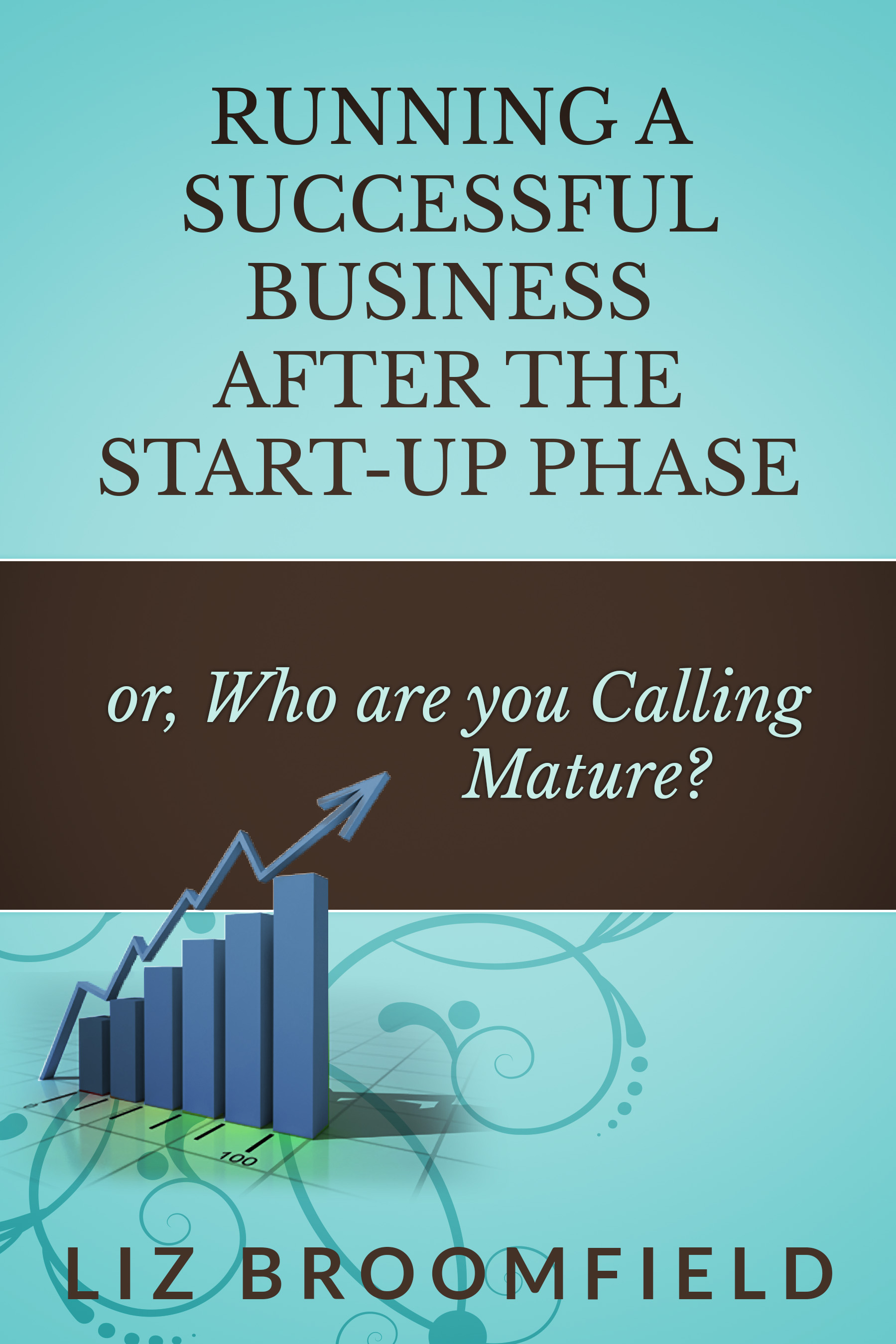
Running a successful business after the start-up phaseI received a delightful email from a reader this morning – it really made my day. They told me how they’d been inspired by my first business book (How I Survived my First Year of Full-Time Self-Employment) and had set up their business, and were now looking forward to my upcoming book on self-mentoring for businesspeople. However, they seemed to have missed the fact that I have also written a book specifically for people who have already set up their business, but want to look at the next stages.

Running a Successful Business after the Start-up Phase covers just these issues. It drills down into using social media and blogging to support and grow your business, but also talks about getting the balance right, increasing your income by getting the right mix of clients, deciding who to work with (once you have the luxury of not having to scramble for Every. Single. Job.) and how to say no (again, once you have the luxury of doing so – although sometimes you just HAVE to say no).

I originally gave this book the title “Who are you Calling Mature?” but feedback suggested the title implied the book was about growing old disgracefully! So I swapped the main and sub-titles round, and re-issued it, but it’s never quite had the success of my other books.

I don’t know if this is because more people start businesses than continue them, or if it’s because people know there are start-up books out there but didn’t realise there are other books on growing and developing your business (I can see that there are fewer of the latter, but I was looking for that information, just like I was looking for information on starting up a business, which is why I blogged about a few of the topics, then wrote the book).

You can also pick up both books together in my Omnibus: Your Guide to Starting and Running your Business, because both of them are useful for new businesspeople, and I want to offer as good value as I can, so there’s a saving on the price of the two books separately.

And now I’m saying it loud and clear: here’s a resource for you if you’ve set up your business, got the basics going, but you want to refine your customer base, get more profitable, get your life back and learn when to say yes and when to say no!

If you have read this book, do let me know what you thought about it, how I could improve the description on Amazon and Smashwords and whether you’ve been inspired to write a review!

Find out more about Running a Successful Business after the Start-up Phase.

Great new book reviews – hooray!

My book sales have returned to normal after a dip in December – I can only put this down to people avoiding Amazon (there was a lot of talk about people boycotting the company for Christmas) and possibly some stuff around their new e-book arrangements. Then there was the fear over the VATMOSS issue – I’m happy to say that my prices have only ended up going up by about 15p for the higher-priced ones and I’ve left them there for the time being. I won’t see any of that extra money – it goes straight to the government in the form of VAT paid by Amazon (I hope!).

Anyway, I’ve been mightily cheered by two lovely reviews for my books …

How I survived my first year of full-time self-employmentThis review of How I Survived my First Year of Full-Time Self-Employment (was it really three years ago that I spent my January working hard once I’d got through my jury service?) was posted on 11 January …

Great break-down guide! … Liz’s tone is one you can relate to as it is approachable and warm. There are no gimmicks to this book; it delivers what it says … (see the whole review here)

It’s so lovely when someone really gets what you’re trying to do and picks up the aims of your book, so even though this review is short, it was very valuable and cheering to read. That’s my 24th four- or five-star review on Amazon UK for this book!

Find out more about this book here.

quick guide to your career in transcriptionAnd this longer review appeared over the weekend for Quick Guide to your Career in Transcription. I’m so pleased when I hear that I inspire people – it’s what I write my website and these books for. So, thank you, all of my lovely reviewers!

The most helpful book for anyone wanting to get into transcription I have just finished reading your book Liz and am completely inspired … Your tips were invaluable … Your encouragement is truly inspirational. (read the whole review here)

Find out more about this book here.

Anyone who writes books will tell you that reviews (good ones, or helpful ones, anyway) really make their day. Making that connection, knowing you’ve entertained, inspired or helped someone – priceless!

A lovely Canadian review for “Quick Guide to your Career in Transcription”

quick guide to your career in transcriptionI received a message from a very nice woman who had read a few of my books and wanted to ask a few more questions about transcription careers. I noted that she was in Canada and checked Amazon Canada to see if she’d reviewed any of them (I wish I got automatically notified of new reviews – if you know how to do this, please let me know!) and found this lovely review for my “Quick Guide to your Career in Transcription”:

Marvelous book filled with very helpful information … I’m so glad I came across this book. (Read the whole review here)

I was particularly pleased to receive this after a rather horrid and misleading review on my Cholesterol book which I’m not going to dwell on, but was quite upsetting when lots of people are going to be looking at that book after spotting it in the magazine. If you have read and not reviewed that one, well, I’m hoping some new reviews will push the one-star one down the list of recent reviews a bit.

Anyway, I’m really pleased to have my Canadian review! If you’re in Canada and want to have a look at my books on Amazon, they’re listed here.

A quick note while I’m here – Amazon have put up my UK and EU e-book prices a little  bit, to take account of the VAT increase imposed by the UK and EU governments but affecting us small sellers and buyers more than the big guys it was aimed at (search for VATMOSS or VATMESS for more info). I’ve left the changes as they are for the time being, to see how things settle – it’s only added about 10p to the cost of my most expensive books, so hopefully that won’t be too much of a burden.

Want to read this book? Have a look here for info and links to Amazon, Smashwords, etc., where you can buy.

Exciting news! “How I Conquered High Cholesterol” in the media

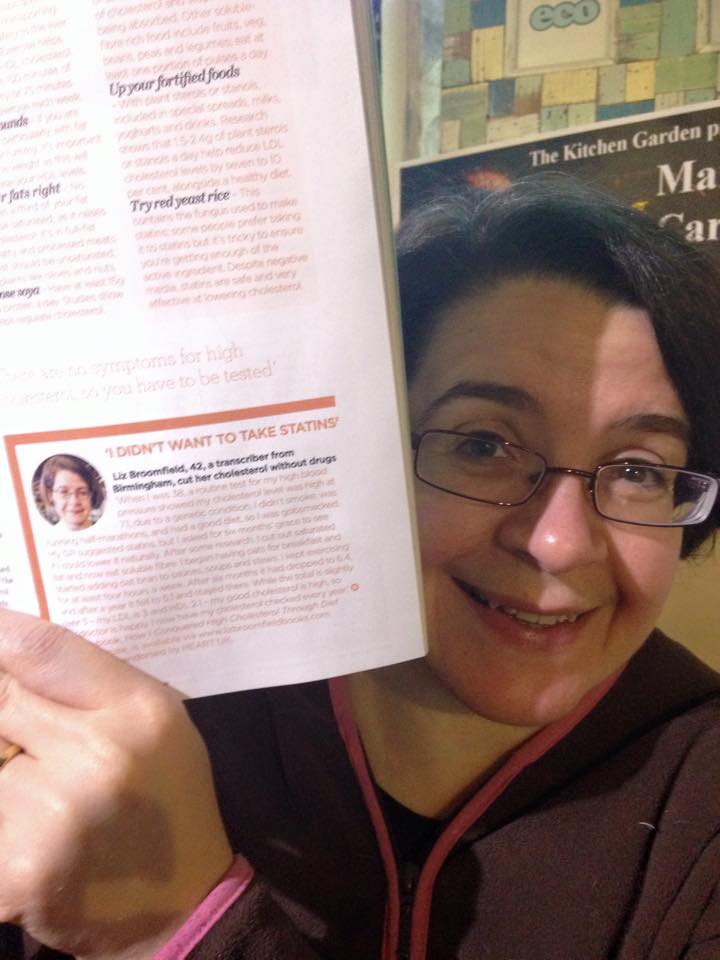
Liz Broomfield with article on Cholesterol book
Thanks to Gill Rose for the photograph

I was interviewed by journalist Jo Willacy a few months ago and here’s the result – a lovely feature in “Healthy”, the UK’s top well-being magazine, which is stocked in Holland and Barratt health food shops. I was really chuffed to find myself in the mag, with a lovely write-up and a mention of this website (so, hello to anyone visiting after reading the article!) and the book I wrote after bringing my own cholesterol levels down myself. Excellent publicity, and I hope this will help my book to help more people in the New Year!

Let me know if you’ve spotted the article in your local Holland and Barratt shop (it’s on p. 53), and thanks to the friend who put the journalist in touch with me in the first place.

You can read more about “How I Conquered High Cholesterol Through Diet and Exercise” and find links to buy it here.

Fiction, non-fiction and creativity – an interview with Sandy Appleyard

hand writingI’ve been talking about creativity in non-fiction writing recently and here we have the next in my interview series on the subject. Today we’re chatting with Sandy Appleyard, a Canadian writer who has made the move from non-fiction to fiction and has some interesting things to say about the processes involved in both.

Hello, Sandy, and thanks for joining in the discussion. Tell me a bit about yourself first, please …

I’m a Canadian multi-genre author and I’ve written both fiction and non-fiction. My writing began with non-fiction and then I moved to fiction. Recently I self-published another non-fiction but then right after another fiction…I seem to be flip-flopping! Writing non-fiction for me was inspired by the need to share personal life stories. Afterward, since I’ve read so many fiction titles I wanted to take a stab at it myself.

How did you start writing, and which came first, fiction or non-fiction?

Writing started out for me as a way to memorialize my father, who died of alcoholism back in 1992.  Then, after several years of battling a back deformity, I decided to write an inspirational memoir about Scoliosis.  Finally, I ran out of personal material, and after voraciously reading fiction all my life, it occurred to me to give writing romantic suspense a try.  I’ve been hooked ever since.

I recently blogged about finding that writing non-fiction was still “creative”. Do you agree, or is only fiction writing truly creative?

Writing fiction and non-fiction, for me, is very different. With non-fiction, while it is still creative writing, the creativity is more in eloquently stating your feelings/beliefs so your readers understand the situation that you were in. This exercise was certainly helpful when switching to fiction because it enabled me to write in that same fashion so readers could understand how the characters felt.

I’ve heard it said that memoir should be considered as “creative non-fiction” – do you agree with that description? How do you think writing memoir differ from writing fiction on the one hand and non-fiction on the other?

With fiction as opposed to non-fiction, you need to add other things like suspense, love scenes, etc., and a big factor-it’s all made up! Writers, myself included, often use our life experiences when writing fiction so we know what situations are like first hand. If we don’t have the experience in our back pocket to reference, that’s what research is for!

You can find Sandy’s work on her website or on her author page on Amazon.

Watch out for more interviews, either by subscribing to this blog (see the links in the top right if you’re viewing on a PC or on the drop-down menu if you’re reading on a phone or tablet) or clicking on the “non-fiction creativity” tag.


Fiction, non-fiction and creativity – an interview with Kathleen Dixon Donnelly

hand writingAs part of my discussion of creativity in non-fiction writing I’ve been putting together an interview series with a range of writers on a range of topics. Today it’s time to say hello to Kathleen Dixon Donnelly, an academic researcher, writer on writers and copyeditor, who has plenty to say about non-fiction writing and creativity. I find Kathleen’s comment on people’s assumption that if you’re a writer, you’re a fiction writer, very interesting: I think there’s a lot more going on for fiction writers, a lot more synergy, and a lot more willingness to invite them to do readings and discussion sessions. But as Kathleen says and I’ve come to realise, writing non-fiction is creative, too, and it certainly doesn’t mean that you put out boring books!

Hello, Kathleen, and welcome to the interview series. First of all, tell me a bit about yourself and your books (a paragraph will do).

My academic research for my Ph.D. in communications was about ‘writers who hung out together.’ This included four salons in the early 20th century: W B Yeats and the Irish Literary Renaissance, Virginia Woolf and the Bloomsbury Group, Gertrude Stein and the Americans in Paris, and Dorothy Parker and the Algonquin Round Table. Now I write and give presentations about them—their lives, their loves, their times, more than about their works—without most of the academic part.

Having just started to wind down my full-time teaching career, I am working at home on projects, including copyediting and proofreading for others. Oops. Two paragraphs.

How did you start writing, and which came first, fiction or non-fiction?

I’ve always been a non-fiction writer. I like reading fiction, but for writing, I never felt I could make stuff up that had any credibility. The older I get, the more I realize how bizarre real life is, so who needs fiction?!

Did you always want to write non-fiction?

I have wanted to ‘be a writer’ since my mother taught me to sign my Christmas cards when I was three. God bless her.

I recently blogged about finding that writing non-fiction was still “creative”. Do you agree, or is only fiction writing truly creative?

Ha! Don’t get me started. My best teacher at university told us in our Writing Non-Fiction module that it was every bit as creative. The godfather of the Creative Non-fiction Foundation [CNF], Lee Gutkind [whom I used to hang out with in a group at Sodini’s restaurant in Pittsburgh in the 1970s], was quite insulted when I called him once to ask for recommendations for a guest speaker about creativity, and said I wanted a fiction writer. He misunderstood why, for that particular slot, I wanted a novelist, and I didn’t have time to explain to him that I personally have always felt non-fiction is equally creative. He’s never published any of my stuff—not sure if these two incidents are related…

I’ve heard it said that memoir should be considered as “creative non-fiction” – do you agree with that description? How do you think writing memoir differs from writing fiction on the one hand and non-fiction on the other?

‘Creative non-fiction’ is a better term than ‘life writing,’ and the CNF has campaigned to use this term consistently. Their motto is ‘You can’t make this stuff up.’ I’ve got the mug. And the t-shirt.

I would include memoir, but also a whole lot of genres:  biography, science writing, even technical writing is creative if well done. A broad definition of creativity is that it means bringing together two things that weren’t together before.

If you use your own life in your fiction, is writing memoir different from doing that?

I don’t do fiction. But, in addition to ‘my writers,’ I have done a lot of blogging about my travels under the name Gypsy Teacher.

Have you got anything else you want to add about creativity and writing (with particular regard to non-fiction)?

I have been very disappointed in the reactions of people here in the UK, particularly other writers, when I say I write non-fiction. They instantly think of technical writing or reporting or something boring. It appears that the default position is that, if you are a writer, you’re writing a novel.

At one workshop, I made a comment, and the tutor said, ‘So life sometimes follows fiction…’ No. Fiction follows life. That’s where we get our stories and ideas from. I just prefer to write my interpretation of how they actually happened, rather than use them as a starting point for invented stories. I really admire those who can do that, but it just ain’t my style…

Thank you, Kathleen. Finally, tell us where we can find your books!

They are all self-published, which, for me, is a disappointment. Self-publishing is a good way to go, but I still hope to have the recognition of a legitimate publisher wanting to take me on.

My blog about the writers, ‘Such Friends,’ is updated monthly and also includes other pieces. I also tweet about them @SuchFriends. I have self-published a copy of my master’s thesis, Manager as Muse: A Case Study of Maxwell Perkins’ Work with F. Scott Fitzgerald, Ernest Hemingway and Thomas Wolfe at Lulu.com . Because a major motion picture about Perkins, starring Colin Firth and Jude Law as Wolfe, is currently in production, I have published a less academic version on CreateSpace in both print and Kindle formats (the official launch date isn’t until February, but you’re all welcome to take a look at it now).

My Gypsy Teacher blog is no longer posted [thanks a lot, Blogger], but I have collected the posts into ‘blooks’ at Lulu and I tweet @gypsyteacher1. The most recent blog post, from May 2013, is still available.

Reviving my freelance business, K. Donnelly Communications, I have started a new blog, where I have been blogging about writing and editing.

Watch out for more interviews, either by subscribing to this blog (see the links in the top right if you’re viewing on a PC or on the drop-down menu if you’re reading on a phone or tablet) or clicking on the “non-fiction creativity” tag.


Three lovely new book reviews!

I’ve been seeing a drop in my book sales recently; whether that’s to do with the Amazon boycott or people not wanting to start new businesses in December, I’m not sure. But I was mightily cheered by these three recent reviews for my books!

Your guide to starting and building your businessFirst off, a lovely note about my Omnibus edition of my two business books – which I created to give the best value I could, as it’s a lower price than the two bought separately.

Wise advice. … The book is packed with calm, realistic advice drawn from Liz Broomfield’s own experience as someone who isn’t a high-flying, entrepreneur, but has built herself a sustainable and successful business … She makes no empty promises, but delivers sense and practicality on every page. (Read the full review here)

quick guide to your career in transcription

Secondly, this just in on my Quick Guide to your Career in Transcription:

Excellent, accessible guide. Really useful, pithy, no nonsense guide … I will definitely use Liz Broomfield’s advice and I’m sure I’ll regularly dip into this ebook for her useful tips. (Read the full review here)

I’m so pleased that this one is continuing to help people with new careers.

Quick guide to networking, social media and social capital

And last but not least, the third review for my newest book, Quick Guide to Networking, Social Media and Social Capital:

A useful and well-written guide to social media. … The information is explained very clearly so as to be easy for even a newcomer to internet social networking to use, yet the guide is detailed enough for those more experienced in social media to also learn something from. It is well worth picking up … (Read the full review here)

How lovely! As ever, I’m so glad I’m helping people – that’s why I got into writing books in the first place! And it’s encouraged me to push on with my next writing project, a version of the omnibus just for editors and proofreaders, and a self-mentoring guide for anyone who is setting up or running a small business!

Find out more about Your Guide to Starting and Building your Business, Quick Guide to your Career in Transcription and Quick Guide to Networking, Social Media and Social Capital including where and how to buy by following the links.

Fiction, non-fiction and creativity – an interview with Caitlin Hicks

hand writingWelcome to another interview in my series on creativity in non-fiction writing which I kicked off a month or so ago. Today we meet Caitlin Hicks, who writes for the theatre, having started out in journalism and has recently blended non-fiction and fiction in her new project, which started with a true story and expanded outwards from there. Let’s say hello to Caitlin and hear her opinions on creativity, non-fiction and fiction. Over to you, Caitlin …

First of all, please tell me a bit about yourself and your books.

My life and work have been profoundly affected by the central circumstance of my existence: I was born into a very large military Catholic family in the United States of America. As a child surrounded by many others, I wrote, performed and directed family plays with my numerous brothers and sisters. I graduated Cum Laude with a double major in French and English (with a writing emphasis) from Loyola Marymount University of Los Angeles. Here, I wrote weekly columns as Feature Editor of the Los Angeles Loyolan. My first job out of school was a writer of Camp Fund stories at the Los Angeles Times, and my writing was published every day of the summer. I worked in radio for several years in San Francisco for CBS and NBC, where I was Manager of Advertising and Promotion for KYUU-FM and where my writing was heard on-air. When I was 26, I dropped out of the corporate world to follow a lifelong dream to become an actress. At the same time, I met my creative soul mate in an Improvisation class — an accomplished artist from Canada named Gordon Halloran.

In Toronto, I began writing for the theatre when, as an actress working on a solo show, The Tarragon Theatre invited me to be a member of the Playwrights Unit there. My first play Six Palm Trees, co-written with Gordon Halloran, came out of that effort. As a playwright and performer I toured with my partner Gord Halloran, in my original theatrical plays in Canada and internationally to standing ovations and excellent reviews. One of my plays was adapted to a feature film called Singing the Bones. While Gord worked as dramaturge and director to my theatre work, I have promoted his work as an artist ever since I met him over 30 years ago.

My path as a writer has always been a personal spiritual journey, although my work is not religious. I am drawn towards stories that I don’t hear often in the mainstream culture. I enjoy bringing to life personal, pivotal stories which have the kernel of transformation and which connect us all to each other.

How did you start writing, and which came first, fiction or non-fiction?

When I was in 4th Grade, I wrote a story called “An approaching storm”  . . . the following week, the teacher read it aloud in class, but I wasn’t there that day, I was sick. But the thrill of writing that story is what got me hooked.

Did you always want to write or was this a relatively late development?

I also wanted to be an artist (as I loved painting and drawing) but my older sister chose to be an ‘artist’ . . . So I decided , I’ll be a writer!

I recently blogged about finding that writing non-fiction was still “creative”. Do you agree, or is only fiction writing truly creative?

Absolutely. It’s a genre: Creative Non-Fiction. I write fiction as well as non-fiction and I approach writing a non-fiction story in the same way I approach writing fiction. Use of vocabulary, language, emotional investment in story, plot, characters, editing, etc. It’s largely instinctive at this point. For me, I must have an emotional connection to the idea inherent in the story before I am even interested in writing it. Right now on my website there is a non-fiction story called NEXT OF KIN, a true story that inspired an aspect of my debut novel A THEORY OF EXPANDED LOVE. That’s why NEXT OF KIN is a great example of what I’m talking about. It could be fiction, but it’s not. It packs an emotional punch, but it’s tightly edited, has a structure, a plot, an arc, etc.

I’ve heard it said that memoir should be considered as “creative non-fiction” – do you agree with that description?

Not all memoirs are Creative Non-Fiction, I guess. I’m thinking that the care with which one writes a fiction story ought also to be in any non-fiction piece.

How do you think writing memoir differs from writing fiction?

Well with memoir, you don’t have to do as much research. You know more about what you’re writing from the get-go.

If you use your own life in your fiction, was writing a memoir different from doing that?

Yes, a memoir is more difficult because you can always offend real people . If it’s fiction, then . . . it’s their choice if they want to insert themselves into the story. I love that I wrote NEXT OF KIN first and was true to the experience. I also love that I could use that experience to inform what happened in A THEORY OF EXPANDED LOVE.

Have you got anything else you want to add about creativity and writing (with particular regard to non-fiction)?

You’re either using the creative side of your brain, or you’re not. Fiction or non.

Caitlin Hicks, authorTell us where we can find your books!

Light Messages is publishing A THEORY OF EXPANDED LOVE. It comes out in May, 2015. My website is at www.caitlinhicks.com/wordpress and you can find NEXT OF KIN there as well as other information and writing.

Watch out for more interviews, either by subscribing to this blog (see the links in the top right if you’re viewing on a PC or on the drop-down menu if you’re reading on a phone or tablet) or clicking on the “non-fiction creativity” tag.


Fiction, non-fiction and creativity – an interview with Joey Avniel

hand writingI’ve been talking about creativity in non-fiction writing recently and here we have the next in my interview series on the subject. Today we’re meeting Joey Avniel, who’s written fiction based on memoir, non-fiction based on family issues he’s experienced, and a health-related book based on his experiences as a vegan (I love books like that, and wrote my own anti-cholesterol diet book out of my research on that topic, so it’s nice to “meet” other people who’ve done the same). Read how Joey’s crafted experiences from his life into three very different books, and if you have any questions, do post a comment!

Hello, Joey, and thanks for joining in the discussion. Tell me a bit about yourself first, please …

I worked for many years as a coach and in my first books I shared the insights of my own experience and what I’ve learned working with my students. My first book was a fiction book and it’s called: One-Legged Seagull: A Warrior’s Journey to Inner Peace. Then my second one was a non-fiction one, about fixing the relationship with your mother. It’s called: Drama with Mama – Eleven Ways To Stop Fighting With Your Mother. Then, since I’m an enthusiastic vegan, and I did a lot of research, about health and diet, I wrote my last book which is called: The Healing Foods – Heal Your Body & Lose Weight with Delicious, Earth-friendly, Healthy Food.

How did you start writing, and which came first, fiction or non-fiction?

My first book was fiction, based on my life path. You can say that the book choose me and forced me to write it. I simply couldn’t fall asleep at night, if I didn’t write some.

Did you always want to write (a memoir / non-fiction) or was this a relatively late development?

After I published my fiction story, I felt like I need to introduce the insights from the fiction book also in a non-fiction way.

I recently blogged about finding that writing non-fiction was still “creative”. Do you agree, or is only fiction writing truly creative?

Writing a good non-fiction book is very creative. If you want to touch your readers’ heart, you need to be creative. They need to feel you and your writing, whether it’s fiction or non-fiction.

I’ve heard it said that memoir should be considered as “creative non-fiction” – do you agree with that description? How do you think writing memoir differ from writing fiction on the one hand and non-fiction on the other?

I used my own life story in my fiction book, changing it of course, to make the book more interesting. Every character has a bit of me in it. Then, in my second book, a non-fiction one, I use a lot of stories from my own life and my relationships with my parents. But, it’s not a memoir. One thing I can say is that I like the freedom of rewriting my life story when writing fiction.

You can find Joey’s books on Amazon, and he also has a Facebook page.

Watch out for more interviews, either by subscribing to this blog (see the links in the top right if you’re viewing on a PC or on the drop-down menu if you’re reading on a phone or tablet) or clicking on the “non-fiction creativity” tag.